Retargeting Ads Design: Win Back Abandoning Customers starts with a simple truth: most shoppers who put items in a cart never finish the purchase. Roughly seven in ten carts get left behind, according to the Baymard Institute’s long-running average across dozens of studies. That abandoned revenue is not gone forever. The right ad creative, shown at the right moment to the right people, pulls a meaningful share of those shoppers back.
Here’s the quick overview of what works in 2026:
- Segment by actual behavior—cart abandoners need different ads than product viewers or past buyers.
- Match the creative to the likely objection (shipping cost, trust, timing) instead of blasting a generic “Come back” message.
- Keep frequency tight and creative fresh so the same people do not see the same ad ten times.
- Pair dynamic product ads with sequential messaging that moves from reminder to social proof to a final nudge.
- Measure recovery rate and incremental lift, not just last-click ROAS.
Get the design right and you stop paying to reacquire customers you already had. Get it wrong and you burn budget while annoying people who already almost bought from you.
Why Retargeting Ads Design: Win Back Abandoning Customers Still Pays Off in 2026
Cart abandonment has barely budged for more than a decade. Shoppers still add products, hit an unexpected shipping total, decide to “think about it,” or simply get distracted. Privacy changes and cookie limits made broad tracking harder, but first-party signals from your own pixel, catalog, and CRM remain strong enough to reach the people who already showed intent.
What usually happens is this: a shopper leaves, sees nothing relevant for a week, then sees the same static banner fifteen times. They either ignore it or actively dislike the brand. The alternative is tighter audiences, smarter creative, and a sequence that feels helpful rather than stalkerish.
In my experience running these campaigns for e-commerce brands, the biggest lift comes from treating cart abandoners as a distinct high-intent pool rather than dumping them into a general “website visitors” list. A $400 cart that almost checked out deserves a different bid and a different message than a $25 impulse view.
Core Principles of Retargeting Ads Design: Win Back Abandoning Customers
Start with the behavior, not the creative. Someone who added to cart and reached checkout is hotter than someone who only viewed a product page. Someone who viewed the same product three times is hotter than a one-and-done browser. Build separate audiences for:
- Cart or checkout abandoners (usually 1–7 day window)
- Product viewers who never added to cart (3–14 days)
- Past purchasers who have gone quiet
Exclude people who already bought. Nothing kills trust faster than advertising a product someone just paid for.
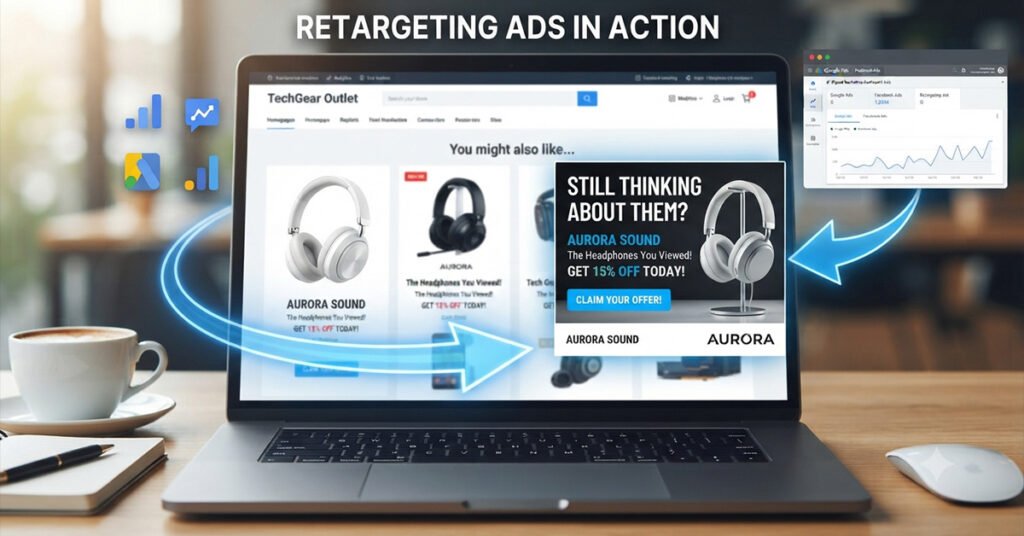
Dynamic product ads (the ones that automatically pull the exact SKU the shopper looked at) consistently outperform generic brand creative for this audience. Pair them with clear, objection-focused copy. If shipping costs are the usual killer, lead with free-shipping language. If trust is the issue, lead with reviews or a guarantee.
Frequency caps matter more than most people admit. Cart abandoners can handle a short, intense burst—three to five impressions in the first 48–72 hours—then drop off. Keep the same creative running longer than two weeks and performance usually tanks.
Step-by-Step Action Plan for Beginners
- Install and verify tracking. Confirm your Meta Pixel (or Conversions API) and Google tag fire on AddToCart, InitiateCheckout, and Purchase. Test with the browser extensions. Without clean events you cannot build clean audiences.
- Create the core audiences. In Meta Ads Manager or Google Ads Audience Manager, build:
- Add-to-cart but no purchase in the last 7 days
- Product viewers (no add-to-cart) in the last 14 days
- Exclude recent purchasers for at least 14–30 days depending on your repurchase cycle
- Set up a catalog sales or dynamic remarketing campaign. Connect your product feed. Let the platform pull the exact items the shopper engaged with. Use the Catalog Sales objective on Meta or Dynamic Remarketing on Google.
- Write three creative variants for the hottest segment.
- Variant A: Simple product reminder + “Still interested?”
- Variant B: Social proof (star rating, review snippet, or UGC)
- Variant C: Specific friction remover (free shipping, easy returns, limited stock)
- Apply frequency caps and exclusions. Cap cart-abandoner ads at roughly 3–5 impressions in the first few days, then lower. Exclude converters daily if possible.
- Launch with a modest daily budget and watch the first 7–10 days. Look at recovery rate (recovered carts ÷ abandoned carts) and cost per recovered order, not just ROAS.
- Rotate creative every 10–14 days. When frequency climbs and CTR drops, swap the hook or the offer. The product can stay the same; the framing needs to change.
If I were starting a new account tomorrow, I would put 60–70% of the early retargeting budget on the 1–7 day cart-abandoner pool and keep the creative simple and direct. Complexity comes later.
Creative That Actually Brings Shoppers Back
The best retargeting ads feel like a helpful nudge, not a sales pitch. Dynamic carousels showing the exact items left behind still win for most catalogs. Single-image or short video works better when the product needs explanation or when you want to lead with a strong testimonial.
Copy should answer the question the shopper is probably asking themselves. “Did I leave something?” is fine for day one. By day four or five, shift to “Free shipping on this order” or “4.8 stars from 2,400 buyers.” Avoid stacking three offers in one ad. One clear reason to return beats a crowded message.
Vertical video and Reels-style UGC perform well on Meta placements because they look native. Keep the first two seconds visual and product-focused; most people watch with sound off.
Refresh cadence is non-negotiable. Small retargeting pools burn through creative fast. Plan to produce or adapt new variants every couple of weeks for active segments.
Common Mistakes & How to Fix Them
Running one giant “all visitors” audience.
Fix: Split by intent and recency. Bid higher and message harder on the hottest lists.
Showing the same ad for a month.
Fix: Set a hard creative refresh schedule and use automated rules that pause ads when frequency exceeds a threshold and performance drops.
Offering discounts too early or too often.
Fix: Start with reminders and social proof. Save the incentive for later in the sequence or for higher-value carts. Constant discounts train shoppers to wait.
Ignoring mobile experience.
Most abandonment happens on mobile. Make sure the landing page the ad points to is fast, has guest checkout, and shows total cost early.
No exclusion for recent buyers.
Fix: Build purchase-exclusion audiences and apply them at the campaign or ad-set level. Update them frequently.
Measuring only last-click ROAS.
Retargeting often assists conversions that get credited elsewhere. Look at overall recovery rate and, when possible, lift studies.
Comparison of Creative Approaches for Cart Abandoners
| Approach | Best For | Strengths | Weaknesses | Typical Window |
|---|---|---|---|---|
| Dynamic product reminder | Most e-commerce catalogs | Highest relevance, automatic personalization | Can feel repetitive if not rotated | Days 1–3 |
| Social proof / UGC | Trust-sensitive categories | Builds confidence without discounting | Needs strong review assets | Days 3–7 |
| Objection handler (shipping, returns) | High cart-value or complex products | Directly removes friction | Requires knowing the main blockers | Days 2–5 |
| Soft incentive (free shipping or small % off) | Price-sensitive or competitive categories | Clears final hesitation | Margin impact if overused | Days 5–10 |
| Sequential story (reminder → proof → urgency) | Longer consideration cycles | Feels natural, reduces fatigue | More setup and creative work | Full 7–14 day arc |
Key Takeaways
- Cart abandonment still sits near 70%—the recoverable pool is large.
- Segment by behavior and recency; treat cart abandoners as a premium audience.
- Dynamic product ads plus objection-focused copy outperform generic reminders.
- Keep frequency tight and creative fresh to avoid fatigue.
- Start simple: clean tracking, tight 7-day cart list, three creative variants, clear exclusions.
- Measure recovery rate and incremental results, not just platform-reported ROAS.
- Sequence the message: remind first, prove second, incentivize last.
- Pair paid retargeting with email/SMS for multi-channel recovery when possible.
The brands that win at retargeting treat it like a recovery system, not a set-it-and-forget-it campaign. Design the ads around the exact friction that stopped the sale, show them only to people who still have active intent, and get out of the way once the decision is made. Do that consistently and the abandoned carts stop being pure loss and start becoming a reliable second chance.
Open your ads account today, build or tighten that 7-day cart-abandoner audience, and launch one clean dynamic campaign with three fresh creative angles. Track the recovery rate for the next two weeks. That single focused test will tell you more than any general theory.
FAQs
How often should I refresh creative in Retargeting Ads Design: Win Back Abandoning Customers?
Every 10–14 days for active cart-abandoner segments is a solid starting point. Watch frequency and CTR; when both move the wrong way, swap the hook or the offer even if the calendar says otherwise.
Do I need discounts for every retargeting ad?
No. Many high-performing campaigns recover carts with nothing more than a clear product reminder and social proof. Save incentives for later in the sequence or for higher-value carts so you protect margin.
What is the ideal audience window for cart abandoners in 2026?
Most e-commerce brands see the strongest results inside a 1–7 day window. Intent decays fast. Longer windows can work for higher-consideration products, but start tight and expand only if the data supports it.