E-Mail Marketing
Cart Abandonment Email Sequences recover sales you already paid to generate. Roughly seven in ten shoppers who add items to a cart never finish the order, according to the Baymard Institute’s multi-study average. A tight, well-timed email sequence is still one of the highest-ROI recovery channels available in 2026—cheaper than paid media and more direct than a generic newsletter.
Here’s the quick overview of what works:
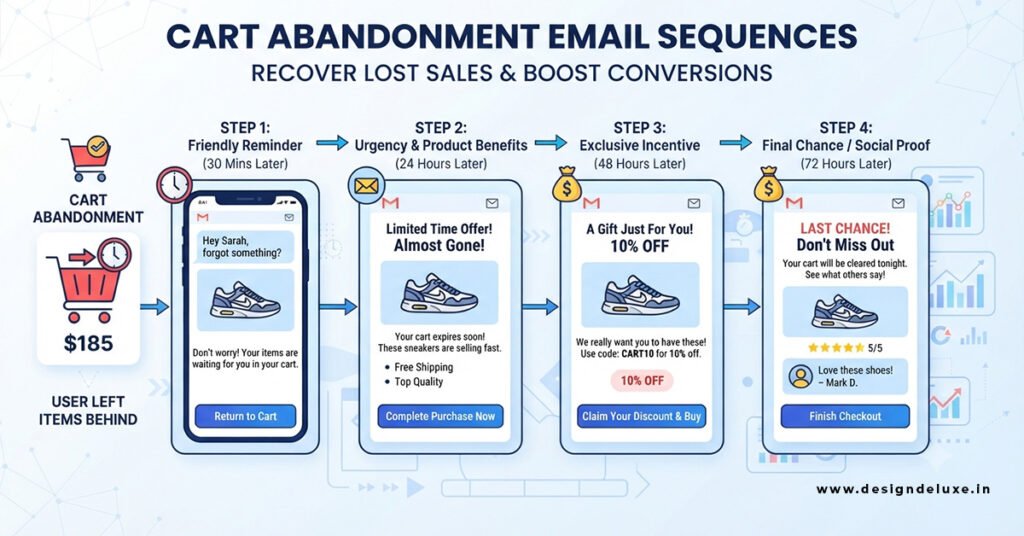
- Send the first email within 30–60 minutes while intent is still hot.
- Use a three-email sequence for most stores: reminder → social proof/objection handling → optional incentive.
- Never discount on email one. Save any offer for the final touch.
- Exit the flow the moment a purchase happens.
- Pair the emails with paid retargeting for maximum recovery.
Get the sequence right and you turn abandoned carts into a predictable revenue stream. Get it wrong and you train customers to wait for discounts while your open rates quietly die.
Why Cart Abandonment Email Sequences Still Work in 2026
Shoppers leave carts for the same reasons they always have: unexpected shipping costs, distraction, comparison shopping, or simple second thoughts. The difference in 2026 is better data and cleaner automation. Platforms like Klaviyo now show abandoned cart flows delivering the highest revenue per recipient of any automated series for many brands.
What usually happens is this: a store runs a single “You left something behind” email 24 hours later, or worse, leads with a 15% off code on the first touch. Both approaches leave money on the table. The first is too slow. The second trains people to abandon on purpose.
In my experience, the biggest gains come from speed on email one and restraint on the offer. A clean reminder sent while the product is still fresh in the shopper’s mind converts a large share of the “got distracted” group without touching your margins.
The Proven Three-Email Structure
Most stores should start with three emails over roughly 72 hours. More emails can work for high-average-order-value products, but three is the reliable baseline that recovers the bulk of available revenue without fatigue.
| Timing | Primary Job | Offer Strategy | |
|---|---|---|---|
| 1 | 30–60 minutes | Simple reminder + product images | No discount |
| 2 | 24 hours | Social proof or objection handling | Still no discount |
| 3 | 48–72 hours | Final nudge with urgency or small incentive | Free shipping or modest % off (if needed) |
Email one does the heavy lifting. Many brands see 40–50% of total recoveries from this single message. Keep it utilitarian: exact items left behind, clear photos, one strong “Complete your order” button that restores the cart.
Email two shifts tone. Address the most common friction points—returns policy, shipping speed, or real customer reviews. This is where trust gets built.
Email three is the only place a limited incentive belongs. Free shipping often outperforms a percentage-off code and protects margin better. If you use a discount, make it time-boxed and specific.
Always suppress anyone who purchases mid-sequence. Nothing looks worse than a “complete your order” email landing after the order already went through.
Step-by-Step Action Plan for Beginners
- Choose or confirm your tool. Shopify’s native abandoned checkout emails are a starting point. For real sequencing, segmentation, and testing, move to a dedicated platform such as Klaviyo.
- Set the trigger correctly. Use “Added to Cart” or “Started Checkout” events. Separate the two if volume allows—checkout abandoners are hotter.
- Build the three-email flow with the timing above. Use dynamic product blocks so the exact items appear automatically.
- Write subject lines that are specific and calm.
- Email 1: “Your [Product Name] is still in your cart”
- Email 2: “Quick answers about shipping & returns”
- Email 3: “Your cart is about to expire”
- Add one clear CTA per email. The button should restore the cart and take the shopper straight to checkout whenever possible.
- Test the exit-on-purchase rule. Place a real test order mid-flow and confirm later emails stop.
- Launch, then watch revenue per recipient and recovery rate. Opens are noisy because of privacy protections. Clicks and actual orders matter more.
If I were setting this up for a new store tomorrow, I would keep the first version extremely simple: three emails, no discount on the first two, and a free-shipping offer only on the third. Complexity and heavy segmentation come after the baseline is proven.
Design and Copy That Converts
Show the products. High-quality images of the exact items left behind still outperform clever copy. Include size, color, and price so the shopper does not have to dig.
Keep the design mobile-first and single-column. Most abandonment happens on phones. A big, thumb-friendly button beats a fancy multi-column layout.
Tone should feel helpful, not salesy. “Still thinking about these?” works better than “LAST CHANCE!!!” on the first two emails. Save honest urgency for the final message.
Personalization helps when it is accurate. First name plus the actual product name lifts opens. Fake urgency or invented scarcity damages trust.
Common Mistakes & How to Fix Them
Sending the first email too late.
Fix: Move it inside the first hour. Intent cools fast.
Leading with a discount.
Fix: Reserve any incentive for email three. A meaningful percentage of recoveries happen with zero offer.
Running the same generic message three times.
Fix: Give each email a distinct job—remind, reassure, then nudge.
No purchase suppression.
Fix: Build a clean exit condition so buyers never receive recovery emails after they convert.
Ignoring mobile rendering.
Fix: Test every email on actual phones. Broken images or tiny buttons kill conversion.
Treating email as the only recovery channel.
Fix: Pair the sequence with paid ads. A strong Cart Abandonment Email Sequence works even better when it runs alongside smart Retargeting Ads Design: Win Back Abandoning Customers that shows the same products across Meta and Google.
Key Takeaways
- Cart abandonment still averages around 70%. Recovery emails remain one of the highest-ROI automations available.
- Three emails timed at roughly 1 hour, 24 hours, and 72 hours cover the useful window for most stores.
- Email one should be a pure reminder with no discount.
- Social proof and friction removal belong in email two.
- Any incentive belongs only in the final message—and free shipping often beats a percentage off.
- Always exit the flow on purchase.
- Measure revenue per recipient and true recovery rate, not just open rates.
- Combine email with paid retargeting for the strongest overall recovery system.
The stores that treat cart recovery as a system rather than a single reminder email consistently pull more revenue from the same traffic. Build the three-email sequence, keep the first two clean of discounts, and make sure every message restores the exact cart with one click. Then layer paid retargeting on top so the shopper sees the same products whether they open their inbox or scroll social media.
Open your email platform today, check the timing on your first abandoned-cart message, and move it inside the first hour if it is not already there. That single change often produces the fastest lift.
FAQs
How many emails should a Cart Abandonment Email Sequence contain?
Three is the reliable baseline for most stores. High-average-order-value products can support four or five over a longer window, but start with three and expand only if the data justifies it.
Should I offer a discount in every abandoned cart email?
No. Leading with a discount trains customers to abandon on purpose and costs margin on shoppers who would have returned anyway. Save any offer for the final email in the sequence.
How does email recovery work with paid retargeting?
Email reaches people who left an address. Paid ads reach a broader set of abandoners. Running both together—especially when the creative is consistent—recovers more carts than either channel alone. A focused approach to Retargeting Ads Design: Win Back Abandoning Customers complements the email sequence rather than competing with it.