DESIGN
Design Tools 2026 can save you a lot of time if you are trying to build a brand, make sales materials, and keep your business looking sharp without hiring a full design team. If you have ever spent too long on a social post, a pitch deck, or a landing page, you already know the pain.
Design Tools 2026 is not really about chasing the newest app. It is about choosing tools that help you move faster, stay consistent, and make your business look credible from day one. In this article, we’re going to be taking a look at Design Tools 2026, and how you can [choose the right tools for your business without wasting money]. If you would like to find out more, feel free to read on.
Pic – CC0 License
What Design Tools 2026 Really Means for Your Business
For most entrepreneurs, design work now covers much more than logos and brochures. You are probably creating social posts, ad graphics, pitch decks, product mockups, short videos, and maybe even simple websites. That is why the best tools are the ones that help you cover several jobs at once.
In 2026, the strongest design stacks are built around speed, teamwork, and ease of use. Businesses are leaning on tools like Canva for quick marketing assets, Figma for collaboration, and AI-supported design platforms for faster drafts and content variation.[12][13] If you are running a lean business in the USA, UK, Australia, Singapore, or Dubai, that mix matters because your time and budget are limited.
The Best Design Tools 2026 for Beginners
If you are just getting started, keep it simple. You do not need ten platforms. You need a few dependable tools that help you create, edit, and publish without a steep learning curve.
Here is the short list we would start with:
- Canva for social graphics, flyers, presentations, and brand kits.[3][16]
- Figma for website mockups, team feedback, and UI design.[13]
- Adobe Express for quick branded content and lightweight editing.
- ChatGPT or Claude for brainstorming copy to pair with your visuals.[5][11]
- Notion for organizing content ideas, launch plans, and design requests.[3][5]
If you are a solo founder, Canva alone can handle a surprising amount of your daily design work.[3][19] If you are working with a freelancer or a small team, Figma becomes more useful because everyone can comment on the same file in one place.[13]
How to Choose Design Tools 2026 Without Overspending
A lot of business owners overspend because they buy tools before they know what problem they are solving. That usually leads to subscriptions you barely use. A better approach is to start with your most frequent design task and build around that.
Ask yourself these questions:
- Are you creating mostly social media content?
- Do you need presentation decks for sales calls?
- Are you designing product screens or websites?
- Do you need fast collaboration with freelancers?
- Do you want AI help for first drafts and variations?
If your main need is marketing content, Canva is usually enough to get moving.[3][16] If your main need is product or web design, Figma should be higher on the list.[13] If your team keeps repeating the same workflow, automation tools like Zapier can connect apps and cut down on manual handoffs.[2][13]
Where AI Fits Into Design Tools 2026
AI is now part of the design process for many small businesses, but it works best as an assistant, not a replacement. You can use AI to draft copy, generate layout ideas, create variations for ads, and speed up rough concepts before polishing them yourself.[1][11][12]
That said, AI should not be your only design system. Your brand still needs a clear look, a steady voice, and human judgment. The best results come when you use AI to save time, then use your own taste to shape the final output.[12][18]
A practical setup looks like this:
- Use AI to brainstorm headline ideas and post copy.[11][12]
- Use Canva or Adobe Express to turn that copy into branded visuals.[3][16]
- Use Figma when the project needs more precise layout work or team review.[13]
- Use Notion to store your brand rules, asset links, and content calendar.[3][5]
A Simple Stack for Small Teams
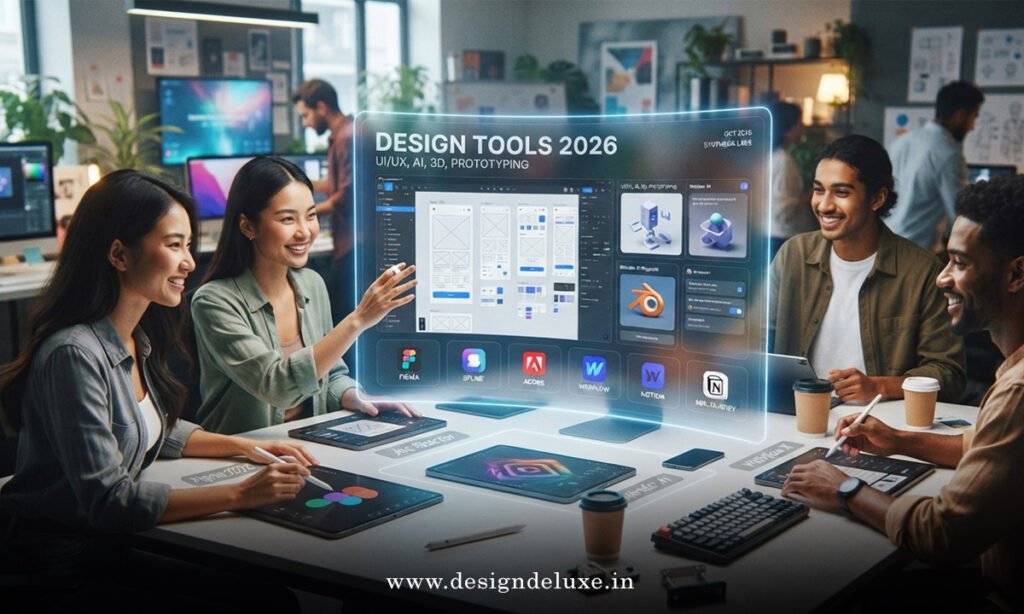
If you want a practical stack rather than a long shopping list, this is the kind of setup many small businesses can live with in 2026:
- Canva for daily marketing design.[3][16]
- Figma for product, web, and client collaboration.[13]
- Notion for planning and file organization.[3][5]
- Zapier for connecting tools and reducing repeat work.[2][13]
- ChatGPT or Claude for idea generation and copy support.[5][11]
- Google Workspace for shared docs, folders, and basic business operations.[3]
This setup works because it covers the full path from idea to output. You can plan in Notion, create in Canva or Figma, then automate handoffs and content updates with Zapier.[2][3][5] That is especially useful if your team is small and you do not want each project to turn into a long email chain.
What to Watch Before You Buy
Not every design tool is worth paying for. Before you subscribe, check three things: whether it fits your current workflow, whether it is easy for your team to learn, and whether it connects with the tools you already use.[12][14] A tool can look impressive and still be a poor fit.
Also think about scale. A tool that works for one founder may not work once you have a designer, a marketer, and an outside agency all touching the same files.[12][14] If you are planning for growth, pick tools that let you share assets, manage versions, and keep your brand consistent across channels.
We hope that you have found this article enlightening in some way, because the real lesson is simple: Design Tools 2026 should make your business easier to run, not harder. Start with one tool for creation, one for collaboration, and one for organization, then add more only when your business truly needs them.