Logo Design
Responsive logo variations guide your brand through the chaos of 2026 touchpoints. One static logo no longer cuts it. Your mark must flex instantly across phone screens, website headers, Instagram ads, packaging, and billboards while staying instantly recognizable.
The truth? Most logos fail in small sizes or unusual contexts. Smart brands build a full system of variations upfront. They avoid blurry favicons, cramped packaging, and lost detail in motion.
Many teams now explore adaptive logo brand design with motion graphics for Instagram ads website and packaging to create cohesive, living identities that perform everywhere.
Why Responsive Logo Variations Matter in 2026
Screens dominate. A logo that looks perfect on desktop often collapses into a muddy blob on mobile. Packaging demands different proportions. Social media thumbnails require ultra-simple marks. Motion adds another layer.
Without variations, you lose recognition, professionalism, and impact. With them, your brand feels polished and intentional across every platform.
Here’s the thing: Responsive doesn’t mean watered-down. It means strategic. You protect core equity while giving designers and marketers flexible tools.
Core Types of Responsive Logo Variations You Need
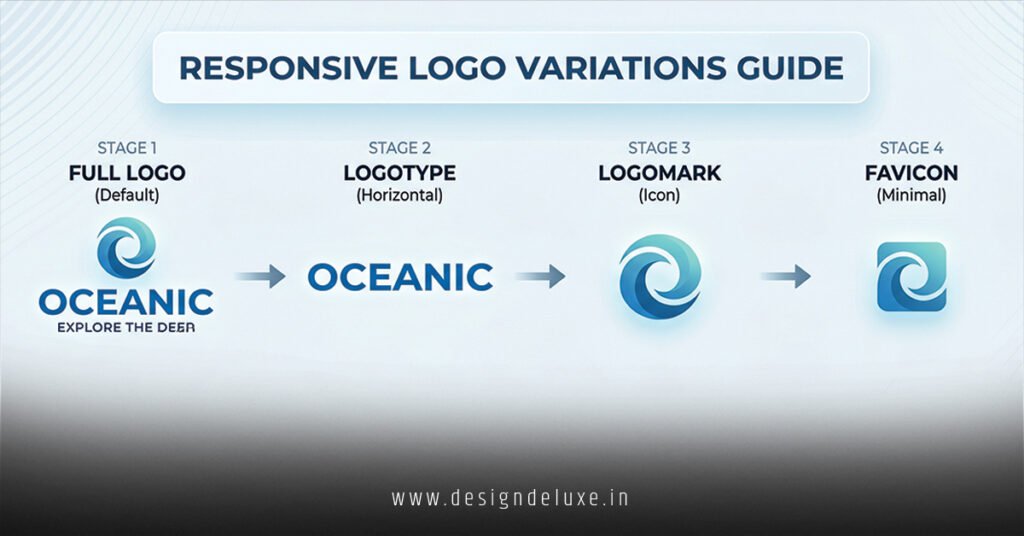
Primary Logo — Full version for large applications like website heroes and print collateral.
Horizontal & Stacked Versions — Layout alternatives for tight spaces.
Icon / Submark — Simplified symbol for favicons, app icons, and small social profiles.
Monogram or Wordmark — Text-focused versions when space is extreme.
Color, Reversed, and Single-Color Versions — For light/dark backgrounds and one-color printing.
Motion-Ready Variants — Simplified elements built for animation without losing clarity.
These variations form a flexible system, not a random collection.
Step-by-Step: Building Your Responsive Logo System
- Start with the Core
Design your primary mark first. Keep it simple enough to survive reduction. - Define Use Cases
List every place the logo lives: mobile, desktop, packaging, social, ads, merchandise. - Create Variations Methodically
Strip details for small sizes. Adjust layouts for proportions. Prepare color versions. - Test Ruthlessly
Check at 16px, on packaging mockups, in motion, and in black & white. - Document Everything
Build a brand guidelines PDF with clear rules for when to use each version. - Prepare Technical Files
SVG for web scalability, high-res raster for print, optimized assets for social.
What I’d do in a new branding project? Sketch 20+ options by hand first, then refine digitally. Always design small versions early — it forces better decisions in the primary mark.
Responsive Logo Variations Comparison Table
| Variation Type | Best Uses | Key Characteristics | Common Pitfalls |
|---|---|---|---|
| Primary (Full) | Website headers, signage, packaging | Complete mark + tagline | Too detailed for small screens |
| Horizontal | Navigation bars, email signatures | Wide layout, compact height | Loses impact on vertical formats |
| Stacked | Mobile headers, business cards | Vertical arrangement | Can feel too tall in wide spaces |
| Icon / Submark | Favicons, app icons, social avatars | Simplified symbol only | Loses brand recognition if over-simplified |
| Reversed / One-Color | Dark modes, embroidery, laser etching | High contrast versions | Muddy results if not tested |
| Motion Variants | Instagram ads, website animations | Clean paths for smooth movement | Overly complex elements distort |
Build at least these six. More if your brand has complex elements.
Best Practices for Different Platforms
Websites & Digital
Use SVG for crisp scaling. Serve different versions via media queries or CSS for mobile vs desktop.
Social Media & Instagram Ads
Prioritize the submark or simplified icon. Ensure it pops in thumbnails and stories.
Packaging
Test on curved surfaces and varying materials. Allow generous clear space.
Motion Graphics
Simplify paths and reduce detail for clean animation. This is where adaptive logo brand design with motion graphics for Instagram ads website and packaging delivers huge advantages.
Common Mistakes and How to Fix Them
Mistake 1: One logo to rule them all.
Fix: Invest in a proper variations suite from day one.
Mistake 2: Overly complex small versions.
Fix: Ruthlessly remove details while protecting recognizability.
Mistake 3: Ignoring motion and animation.
Fix: Design with movement in mind. Clean vectors animate better.
Mistake 4: Poor documentation.
Fix: Create clear brand guidelines with do’s and don’ts.
Mistake 5: Skipping real-world testing.
Fix: Print mockups, view on actual devices, and test packaging prototypes.
Key Takeaways
- Responsive logo variations are non-negotiable in 2026 for multi-channel brands.
- Prioritize simplicity in small-size versions without losing personality.
- Build horizontal, stacked, icon, and color variants as standard.
- Always test across real contexts — digital, print, and motion.
- Document rules clearly for your team and partners.
- Motion-ready adaptations give extra impact on social and ads.
- Connect variations to your full adaptive system for maximum cohesion.
- Review and refine every 2-3 years as platforms evolve.
A strong responsive logo system makes your brand feel professional and modern everywhere it appears. It removes friction for designers and marketers while strengthening recognition.
Ready to upgrade? Audit your current logo at 32px size right now. Identify where it breaks. Then map out the six core variations you need. Exploring adaptive logo brand design with motion graphics for Instagram ads website and packaging can fast-track the full system with cohesive assets.
FAQs
What are responsive logo variations?
Multiple tailored versions of your logo designed to perform optimally across different sizes, formats, and platforms while maintaining brand consistency.
How many logo variations should a brand have in 2026?
At minimum six: primary, horizontal, stacked, icon, reversed, and motion-ready. Complex brands often need more.
Do responsive logos need motion graphics?
Strongly recommended for digital-heavy brands. Motion variants shine on Instagram ads, websites, and animated packaging reveals when built thoughtfully.