Brand
How to build a fashion brand identity comes down to deciding who you are, who you’re for, and what you’ll never compromise on, then expressing that in everything a customer sees, touches, and reads. Here’s the fast version.
- What it is: The complete personality of your label: positioning, voice, visuals, product, and experience.
- Why it matters: It’s the reason someone picks you over a cheaper lookalike.
- What it includes: Mission, audience, name, logo, palette, typography, tone, and packaging.
- Who it’s for: Founders and small teams starting from zero.
Why Brand Identity Comes Before the Collection
Most beginners start with sketches. Smart ones start with a sentence.
I’ve watched designers pour six months into a gorgeous capsule collection with no clear idea of who would buy it. The clothes were fine. The brand was a blur. Nobody could say what the label stood for, so nobody could recommend it.
Identity is the filter that makes every later decision faster. Which fabric? Which photographer? Which Instagram caption? You check it against the identity and the answer is usually obvious.
Think of it as the spine of a garment. You never see it, but it decides how everything else hangs.
What a Fashion Brand Identity Is Made Of
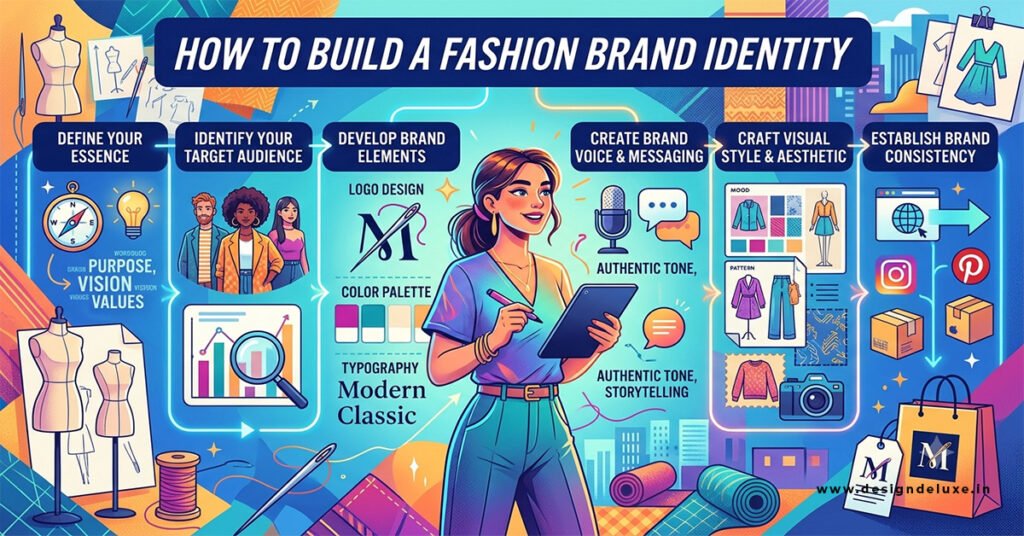
People confuse identity with a logo. A logo is one piece. The full picture has five layers:
- Strategy: Your purpose, audience, and positioning.
- Verbal identity: Name, tagline, and tone of voice.
- Visual identity: Logo, color, type, and imagery style.
- Product identity: Silhouettes, fabrics, and signature details.
- Experience identity: Packaging, website, customer service, and unboxing.
Skip any layer and customers feel the gap, even if they can’t name it.
How to Build a Fashion Brand Identity: Step-by-Step Action Plan
Here’s the order I’d follow with a new label.
- Define your why. Write one honest paragraph on why this brand exists. “Because I love fashion” doesn’t count. Try: “Because workwear for petite women is either shapeless or overpriced.”
- Pick a specific customer. Name her or him. Age range, income, city, what they wear to Tuesday meetings, where they scroll at night. “Everyone” isn’t a customer.
- Study the competition. Map ten brands near you. Note price, aesthetic, tone, and gaps. You’re hunting for the space nobody’s occupying.
- Write your positioning statement. Use this template: “For [customer] who [need], [brand] is the [category] that [benefit], unlike [alternative].”
- Choose three to five brand values. Make them testable. “Quality” is vague. “Every seam is double-stitched” is a promise.
- Name it. Short, pronounceable, and available as a domain and social handle. Then run a trademark search before you fall in love.
- Build the visual system. Palette, typography, logo, and photography direction, written into a one-page style sheet.
- Define your voice. Pick three adjectives (for example, “dry, warm, precise”) and write sample captions in that voice.
- Design the experience. Packaging, product page, email tone, return policy. All of it should feel like one hand made it.
- Test small, then launch. Show the identity to 10 to 20 people in your target audience and ask what they’d say about the brand to a friend.
How to Build a Fashion Brand Identity Around Your Audience
Here’s the thing: identity isn’t about what you like. It’s about what your customer recognizes in themselves.
Research Without a Research Budget
You don’t need a focus group. Interview five to ten people who match your target customer. Ask what frustrates them about shopping, which brands they trust, and what they’d pay more for. Then listen for repeated words. Those words belong in your messaging.
Browse the comment sections and reviews of competitors too. Complaints are free market research.
Turning Insights Into a Positioning Statement
Say your interviews reveal a pattern: customers want elevated basics that survive weekly washing. That’s a positioning opportunity. “Considered everyday clothing that holds its shape” is a clear promise, and you can build a name, palette, and voice around it.
Building the Verbal Identity
Words do more work than most founders expect.
Name and Tagline
A good name is easy to say, easy to spell, and hard to confuse. Test it by saying it out loud on a phone call. If you have to spell it twice, rethink it.
Taglines are optional. If you use one, keep it under six words and make it specific. Skip anything that could belong to any brand.
Tone of Voice
Your voice should sound like a person with opinions. Decide how you’d talk to a customer across a boutique counter, then write like that. Playful, formal, minimalist, irreverent: pick one and hold it across product descriptions, emails, and social posts.
Building the Visual Identity
Visuals are what people notice first, so they need rules.
Logo, Color, and Typography
Keep the logo simple enough to read on a woven label at half an inch wide. Choose a core palette of three to four colors and two typefaces. One for headlines, one for body text. If you’re aiming at a premium look, the principles in Fashion Brand Design: Luxury Aesthetics That Sell show how restraint in color and type signals quality.
Photography and Art Direction
Decide on light, setting, and styling before your first shoot. Natural light and neutral backdrops feel calm and editorial. Saturated color and street casting feel energetic and youthful. Neither is right. Consistency is.
Does every image look like it belongs to the same brand? If not, reshoot or cut it.
Brand Identity Styles Compared
Use this table to see where your label might sit. Here is the table in a clean, copy-paste-ready format:
| Identity Style | Typical Voice | Visual Cues | Best For | Watch Out For |
|---|---|---|---|---|
| Minimalist | Calm, precise, understated | Neutral palette, clean type, generous white space | Essentials, tailoring, knitwear | Blending into the crowd |
| Streetwear | Casual, insider, bold | Graphic logos, urban photography, drops | Hoodies, sneakers, accessories | Trend dependence |
| Heritage | Warm, storytelling, traditional | Serif type, earthy colors, craft imagery | Leather goods, outerwear, denim | Fabricated backstories |
| Playful/Colorful | Witty, friendly, energetic | Bright palettes, illustrated elements, candid shots | Casual wear, accessories, kidswear | Looking unserious at higher prices |
| Sustainable/Conscious | Honest, transparent, grounded | Natural tones, texture-led imagery, minimal packaging | Basics, small-batch collections | Vague green claims |
If you make sustainability claims, follow the FTC’s Green Guides and advertising rules so your wording stays accurate and defensible.
Protecting Your Identity Legally
This step feels boring until someone copies your name.
Search existing marks before you commit, and learn the process through the USPTO trademark basics. Registering your name and logo early is far cheaper than rebranding later. You’ll also want to register your business, and the SBA’s guide to choosing a business name walks through the US-specific steps. For legal advice tailored to your situation, talk to a licensed attorney.
Common Mistakes & How to Fix Them
Mistake 1: Starting with the logo. A logo without strategy is a costume. Fix it by writing your positioning statement first and designing the logo to express it.
Mistake 2: Targeting everyone. Broad brands sound generic. Fix it by naming one core customer and writing everything for her or him.
Mistake 3: Copying a competitor’s look. You’ll always be the second-best version. Fix it by borrowing a principle, not a style, and pointing it at your own story.
Mistake 4: Inconsistent touchpoints. A sleek website and sloppy packaging confuse people. Fix it with a one-page style sheet that covers every channel.
Mistake 5: Trend-chasing. What usually happens is you rebrand every eight months and never build recognition. Fix it by choosing a direction you can hold for at least three years.
Mistake 6: Ignoring the product. Identity promises, product delivers. Fix it by making sure fabric, fit, and finish match what you claim.
Key Takeaways
- A fashion brand identity is a full system: strategy, voice, visuals, product, and experience.
- Start with your why and your customer before touching a logo.
- Write a positioning statement and use it to filter every decision.
- Limit yourself to three or four colors, two typefaces, and one clear tone of voice.
- Pick an identity style from the table and commit to it.
- Make every touchpoint match, from the website to the packaging.
- Check trademarks early and follow US labeling and advertising rules.
- Test your identity with real customers before a full launch.
Final Thoughts
A strong identity makes a small label feel inevitable. Customers don’t just buy a jacket. They buy the person they’ll be in it, and your job is to make that person unmistakable.
Your next step: write your positioning statement today, then build a one-page style sheet around it. From there, explore how luxury cues like restraint, materials, and packaging can sharpen your look.
FAQs
How long does it take to build a fashion brand identity?
Most new labels need four to eight weeks to define strategy, name, voice, and visuals properly. Rushing the strategy phase usually costs more time later.
Can I handle fashion brand identity myself, or do I need a designer?
You can do the strategy and voice yourself. Hiring a freelance designer for the logo and style sheet is often money well spent, but only after your positioning is clear.
What’s the difference between a brand identity and a brand image?
Identity is what you intentionally create: your values, voice, and visuals. Image is what customers actually perceive. The goal when you learn how to build a fashion brand identity is to close the gap between the two.