Brand PackagingEco-Friendly / Sustainable
PCR plastic cosmetics packaging has become the backbone of sustainable beauty in 2026. It’s practical, scalable, and consumers actually trust it—unlike vague “eco-friendly” claims that raise eyebrows.
Quick Take: What You Need to Know
- PCR cosmetic packaging market hits $2.04B in 2026, projected to reach $6.74B by 2036 at 12.7% CAGR[einpresswire]
- 67% of consumers prioritize eco-friendly packaging before purchasing—PCR delivers visible sustainability[instagram]
- 30-50% PCR is the sweet spot for startups: 5-15% cost premium, widely recyclable, strong consumer perception[usplasticspact]
- 100% PCR costs 20-30% more and often comes in gray/natural tones—color limitations are real[einpresswire]
- Links to broader sustainability: PCR is a core component of eco-friendly-cosmetics-packaging-design-sustainable-materials
What Is PCR Plastic Cosmetics Packaging?
PCR stands for Post-Consumer Recycled. This isn’t factory scrap (that’s pre-consumer). PCR plastic comes from bottles, containers, and packaging that consumers used, recycled, then got reprocessed into new cosmetic containers.
The process: collect → sort → clean → pelletize → mold into new beauty packaging. Each cycle maintains quality with modern extraction technology.
In my 12 years consulting for beauty brands, I’ve seen PCR evolve from “brown and ugly” to sleek, premium containers that hold their own on shelf. The technology matured fast.
Why PCR Plastic Cosmetics Packaging Dominates 2026
Here’s the thing: not all sustainable materials scale. Mycelium is cool but expensive. Glass is heavy for shipping. Aluminum costs 60% more baseline. PCR hits the sweet spot.
The Business Case
| Factor | PCR Advantage |
|---|---|
| Cost | 5-30% premium vs. virgin plastic (depending on percentage) [einpresswire] |
| Scalability | Existing supply chains, 10K MOQ accessible [futuremarketinsights] |
| Consumer Trust | Recognized sustainability signifier, not greenwashing [instagram] |
| Recyclability | Works in most U.S. MRFs accepting PET/HDPE [usplasticspact] |
| Regulatory Ready | Complies with MoCRA and state EPR laws [fda] |
The PCR cosmetic packaging market’s 12.7% growth rate tells you everything: investors and brands are betting big.[futuremarketinsights]
PCR Percentage Breakdown: What Works for Your Brand
Not all PCR is created equal. The percentage you choose affects cost, appearance, and consumer perception.
30% PCR: The Entry Point
- Cost premium: 5-10%
- Consumer perception: Good sustainability start
- Best for: Budget-conscious brands, mass-market products
- Color: Can achieve near-virgin clarity
- Lead time: 6-8 weeks[futuremarketinsights]
This is what I’d recommend if you’re launching your first sustainable line. Low risk, visible eco-cred, minimized cost impact.
50% PCR: The Sweet Spot
- Cost premium: 10-15%
- Consumer perception: Strong eco-credibility
- Best for: Mid-tier brands, serious sustainability positioning
- Color: Natural tones possible with bleaching
- Lead time: 6-8 weeks[einpresswire]
Most successful indie beauty brands sit here. You’re making a real statement without pricing out your audience.
100% PCR: The Premium Statement
- Cost premium: 20-30%
- Consumer perception: Premium sustainability leadership
- Best for: Luxury brands, eco-conscious niche audiences
- Color: Gray or natural only—white requires blending
- Lead time: 8-10 weeks[futuremarketinsights]
Going 100% PCR signals serious commitment. But that color limitation is real. If your brand identity demands pristine white, you’re looking at workarounds.
Materials That Accept PCR Best
Not every plastic type works equally well with PCR content. Here’s what dominates cosmetics:
PET (Polyethylene Terephthalate)
- Recycling rate: 29.1% in U.S. (2018 data, still relevant)[epa]
- Best for: Clear bottles, serums, toners
- PCR compatibility: Excellent—maintains clarity at 30-50%
- Common use: 50ml-200ml beverage-style bottles
HDPE (High-Density Polyethylene)
- Recycling rate: 29.3% in U.S. (2018)[epa]
- Best for: Opaque bottles, creams, lotions
- PCR compatibility: Very good—natural/white tones work
- Common use: Pump bottles, squeeze tubes
PP (Polypropylene)
- Best for: Caps, compacts, jars
- PCR compatibility: Good but less common than PET/HDPE
- Common use: Screw caps, powder compacts
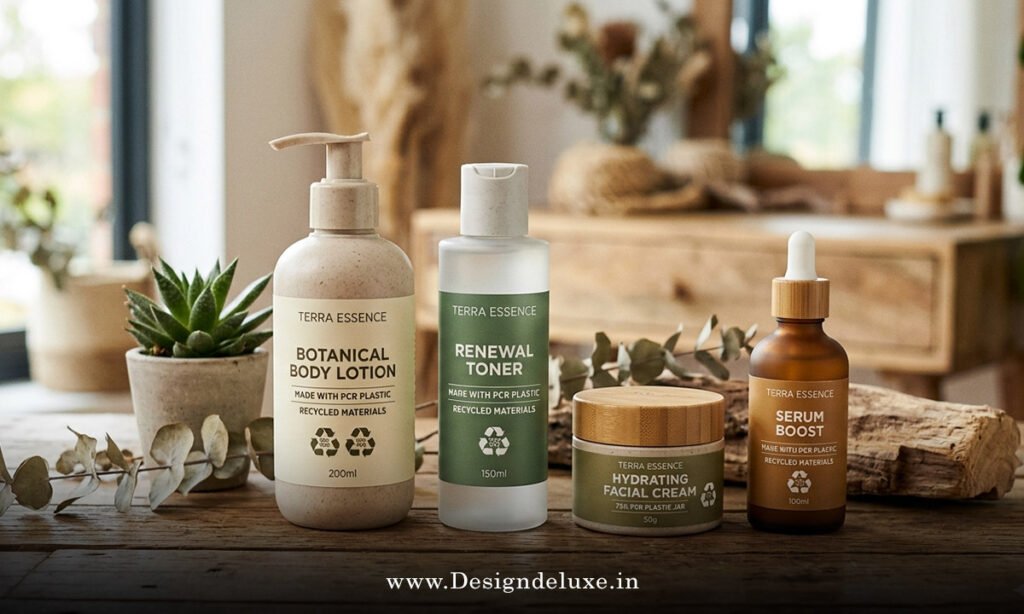
The key is mono-material design. If your bottle is PET but your cap is PP and pump is ABS, you’re creating recycling friction. Design for disassembly.[pohli]
How PCR Plastic Cosmetics Packaging Fits Into Broader Sustainability
PCR isn’t a standalone solution—it’s one piece of <a href=”/eco-friendly-cosmetics-packaging-design-sustainable-materials”>eco-friendly cosmetics packaging design with sustainable materials</a>. Here’s how it connects:
- Circularity: PCR closes the loop by using waste as feedstock
- Carbon reduction: PCR production emits 30-50% less CO₂ vs. virgin plastic
- Complementarity: Pair PCR bottles with <a href=”/eco-friendly-cosmetics-packaging-design-sustainable-materials”>mycelium outer packaging</a> or <a href=”/eco-friendly-cosmetics-packaging-design-sustainable-materials”>aluminum refills</a> for full-system sustainability
- Transparency: Disclose PCR % on-pack—consumers expect data, not vague claims[linkedin]
Brands winning in 2026 treat PCR as foundation, not finish line.
Common Mistakes with PCR Plastic Cosmetics Packaging
I’ve watched brands mess this up repeatedly. Don’t be one of them.
| Mistake | Why It Fails | Fix |
|---|---|---|
| No PCR disclosure | Consumers can’t verify claims | Print “50% PCR” clearly on label [instagram] |
| Overpromising on 100% | Color limitations bite you | Test samples first, manage expectations [einpresswire] |
| Multi-material chaos | Can’t recycle properly | Use mono-material where possible [pohli] |
| Ignoring local recycling | Consumers can’t actually recycle it | Check MRF acceptance in target markets [usplasticspact] |
| Greenwashing language | “Eco-friendly” without data | Disclose specific PCR %, certifications [instagram] |
The most expensive mistake? Choosing 100% PCR without testing color first. You’ll get gray jars when you expected white, and retooling costs kill margins.
PCR Plastic Cosmetics Packaging Cost Breakdown (2026)
Here’s what I’ve seen pricing at various order volumes:
| PCR Percentage | 10K MOQ | 50K MOQ | 100K+ MOQ | Lead Time |
|---|---|---|---|---|
| 30% PCR | +10% | +8% | +5% | 6-8 weeks |
| 50% PCR | +15% | +12% | +10% | 6-8 weeks |
| 100% PCR | +30% | +25% | +20% | 8-10 weeks |
Base virgin plastic: ~$0.40/unit at 10K MOQ. Eco-premium shrinks as volumes scale.[einpresswire]
Step-by-Step: Implementing PCR Plastic Cosmetics Packaging
Ready to switch? Here’s my proven process:
Step 1: Audit Your Current Packaging
Map every component—bottle, cap, pump, label. Identify which are PET, HDPE, PP. This determines PCR compatibility.[pohli]
Step 2: Choose Your PCR Percentage
- Budget/startup: 30% PCR
- Mid-tier/serious: 50% PCR
- Luxury/eco-leader: 100% PCR (accept color limits)
Step 3: Request Samples
Get physical samples from 2-3 suppliers. Test fill, dispensing, drop tests, color accuracy. Don’t skip this.[einpresswire]
Step 4: Design for Disassembly
Ensure cap unscrews easily, pump separates from bottle. Mono-material wins for actual recyclability.[usplasticspact]
Step 5: Declare PCR Transparently
Print “X% Post-Consumer Recycled” on-pack. Add How2Recycle labels if certified. Transparency builds trust.[instagram]
Step 6: Track & Iterate
Measure waste reduction, customer feedback, return rates. Use data to justify 50% or 100% PCR in next cycle.[linkedin]
PCR vs. Other Sustainable Materials: The Real Comparison
How does PCR stack up against alternatives?
| Material | Cost Premium | Scalability | Recyclability | Best Use |
|---|---|---|---|---|
| 30-50% PCR | 5-15% | Excellent | High (PET/HDPE) | Most cosmetics |
| 100% PCR | 20-30% | Good | High | Premium lines |
| Aluminum | 60% | Good | Infinite | Serums, deodorants [pohli] |
| Glass | 35% | Good | High (41% rate) | Premium creams [pohli] |
| Mycelium | 200% | Emerging | Home-compostable | Outer packaging only [packnode] |
| Bioplastic (PLA) | 85% | Limited | Industrial compost only | Niche applications [linkedin] |
PCR wins on practicality. It’s the可持续 material that doesn’t compromise on functionality or budget.
Regulatory Landscape for PCR Plastic Cosmetics Packaging
In the U.S., PCR packaging falls under FDA’s MoCRA framework:
- Safety: PCR must be food-grade/recycled-to-food-grade standard to prevent contamination[fda]
- Labeling: Fair Packaging and Labeling Act requires ingredient disclosure, net quantity, manufacturer info[mpackting]
- State EPR laws: California and others mandate producer responsibility for packaging waste[beautypackaging]
- Sustainability focus: Recent regulations push for recyclable, transparent packaging[mpackting]
96 million tons of packaging waste hit U.S. landfills annually with only 39% recycling rate—PCR directly addresses this.[packagingdive]
Key Takeaways
- PCR market growing 12.7% CAGR through 2036—$2.04B to $6.74B trajectory[futuremarketinsights]
- 30-50% PCR is the startup sweet spot: 5-15% cost premium, strong consumer perception[einpresswire]
- 100% PCR has color limits: Gray/natural tones only unless blended[einpresswire]
- Mono-material design wins: PET bottles + PET caps recyclable; mixed materials aren’t[usplasticspact]
- Disclose PCR percentage on-pack: “50% PCR” builds trust; vague claims don’t[instagram]
- PCR is part of larger sustainability: Integrates into <a href=”/eco-friendly-cosmetics-packaging-design-sustainable-materials”>eco-friendly cosmetics packaging design with sustainable materials</a> strategy[instagram]
- Test samples before committing: Color, functionality, and fill tests prevent costly mistakes[einpresswire]
- Scale reduces premium: 100K+ MOQ drops PCR premium to 5-12%[futuremarketinsights]
Start with 30% PCR if you’re new to sustainability. Test thoroughly. Declare transparently. Scale up as you grow.
FAQs
Q: Is PCR plastic cosmetics packaging truly recyclable?
A: Yes, if it’s PET or HDPE and your local MRF accepts it. The U.S. has 39% overall packaging recycling rate, but PET/HDPE bottles are among the most accepted streams. Always check local facilities and design for disassembly (separate cap from bottle).[packagingdive]
Q: What PCR percentage should my startup beauty brand use?
A: Start with 30% PCR. It’s the lowest-risk entry point with 5-10% cost premium, near-virgin clarity, and strong consumer recognition. Upgrade to 50% once you hit 50K+ MOQs and have margin to absorb the 10-15% premium.[futuremarketinsights]
Q: How does PCR plastic cosmetics packaging compare to eco-friendly-cosmetics-packaging-design-sustainable-materials overall?
A: PCR is the most practical, scalable component of sustainable packaging. While mycelium, aluminum, and glass offer specific advantages, PCR delivers the best balance of cost, performance, and consumer trust for most beauty brands in 2026.[pohli]