Brand
This Design Thinking Guide: Problem-Solving for Brands exists because most companies still solve problems backward — they fall in love with a solution before they’ve actually understood the problem. That’s expensive. It’s also completely avoidable.
Here’s the quick rundown before we go deep:
- What it is: A human-centered, iterative process for solving business problems by starting with real customer pain, not boardroom guesses.
- Why it matters: Brands that skip research and jump straight to building waste budget on products nobody asked for.
- Core stages: Empathize, Define, Ideate, Prototype, Test — popularized by Stanford’s d.school.
- Who uses it: IBM, IDEO, Procter & Gamble, and thousands of smaller D2C brands use versions of this framework daily.
- Beginner takeaway: You don’t need a design degree. You need discipline and a willingness to be wrong early, cheaply.
What Is Design Thinking, Really?
Strip away the sticky notes and whiteboard photos you’ve seen on LinkedIn, and design thinking is just structured empathy. It’s a method for understanding people before you try to serve them.
The term got mainstream traction through Stanford’s d.school, which codified a five-stage model that’s still the backbone of most corporate training programs today.
Think of it like a doctor refusing to prescribe medicine before running tests. Sounds obvious, right? Yet most product teams prescribe first and diagnose never.
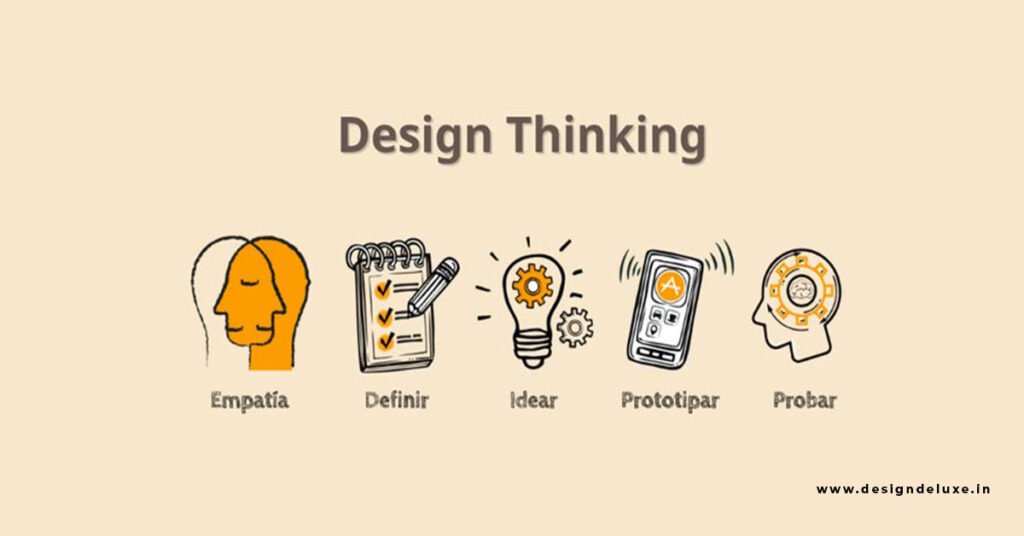
The Five Stages Brands Actually Use
- Empathize — Talk to real customers. Watch them struggle. Take notes, not assumptions.
- Define — Turn that mess of observations into one sharp, specific problem statement.
- Ideate — Generate a wide net of solutions before narrowing down. Quantity first, quality second.
- Prototype — Build the cheapest, fastest version of the idea. Paper, clickable mockup, duct tape — whatever gets you feedback fastest.
- Test — Put it in front of real users again. Then go back and refine.
Notice it loops. It’s not a straight line. It’s more like a spiral staircase — you keep circling back to the same floors, just higher up each time.
Why This Design Thinking Guide Matters for Brands in 2026
Markets move faster now. Customer attention spans are shorter, switching costs are lower, and AI-generated competitors can spin up a lookalike product in weeks.
In my experience, the brands that survive aren’t the ones with the biggest budgets. They’re the ones that get closer to their customer’s actual frustration, faster than the competition does.
The kicker is this: design thinking isn’t a creative department exercise anymore. It’s a risk-management tool. IBM’s own Enterprise Design Thinking framework exists specifically because large-scale product failures are costly, and empathy-first research reduces that blast radius.
Design Thinking Guide: Problem-Solving for Brands — Step-by-Step Action Plan
If you’re starting from zero, don’t overthink the tooling. Overthink the discipline instead. Here’s what I’d actually do, in order.
- Pick one narrow problem. Not “improve customer experience.” Something like “why do 40% of users abandon checkout on mobile.”
- Interview 8–12 real customers. Not your coworkers. Not your investor. Actual users.
- Write a single problem statement. One sentence. If it needs a semicolon, it’s not sharp enough yet.
- Run a 20-minute brainstorm with no judgment allowed. Bad ideas are allowed in the room. Silence is not.
- Build a rough prototype in under a week. Cardboard, Figma, a landing page — speed beats polish here.
- Test with 5 users minimum. The Nielsen Norman Group has long argued that five users typically surface most major usability issues — enough signal without burning your whole budget. (source)
- Iterate, then scale. Only pour real budget in once the prototype earns it.
That’s the whole engine. Everything else is decoration.
Design Thinking Guide: Problem-Solving for Brands — Tools That Actually Help
You don’t need expensive software to start. A whiteboard, sticky notes, and a recorder on your phone will get you through stage one. Once you scale, tools like Figma, Miro, and Dovetail help organize research at team level.
Answer-Ready Comparison: Design Thinking vs. Traditional Problem-Solving
| Factor | Traditional Problem-Solving | Design Thinking Approach |
|---|---|---|
| Starting Point | Internal assumptions, executive opinion | Direct customer observation and interviews |
| Timeline to First Test | Months (full build before feedback) | Days to a few weeks (rough prototype first) |
| Cost of Being Wrong | High — full-scale product/marketing spend | Low — caught during cheap prototyping phase |
| Decision Driver | Data from spreadsheets, competitor copying | Direct user behavior and pain points |
| Risk of Building the Wrong Thing | High | Significantly reduced through iteration |
Common Mistakes & How to Fix Them
Mistake 1: Treating it as a one-time workshop. Teams run one brainstorm session, call it “design thinking,” and never touch it again. Fix: Build the loop into your actual product cycle. It’s a habit, not an event.
Mistake 2: Skipping real customer interviews. Surveys and internal assumptions aren’t the same as watching someone struggle with your product in real time. Fix: Budget time for at least 8–10 live conversations before defining the problem.
Mistake 3: Falling in love with the first idea. This kills more products than bad execution does. Fix: Force yourself to generate at least 15–20 ideas before picking a direction.
Mistake 4: Building a “prototype” that takes three months. If it’s expensive to make, it’s not a prototype anymore — it’s a product you’re now emotionally attached to. Fix: Set a hard time cap. Five days, max, for version one.
Mistake 5: Testing with the wrong audience. Testing a B2B tool with your office intern tells you nothing useful. Fix: Recruit actual target users, even if it’s just five people from your existing customer list.
Key Takeaways
- A Design Thinking Guide: Problem-Solving for Brands only works when empathy comes before execution — not after.
- The five core stages are Empathize, Define, Ideate, Prototype, and Test, and they loop rather than run in a straight line.
- Brands that skip direct customer interviews tend to build solutions nobody asked for.
- Prototypes should be fast and cheap. Speed matters more than polish in early stages.
- Testing with a small group of real users, often five to ten, catches most major problems early, according to usability research from the Nielsen Norman Group.
- The biggest failure point isn’t creativity — it’s discipline. Teams abandon the process halfway through.
- Large organizations like IBM have formalized this into enterprise-wide frameworks because it reduces costly product failures.
- Smaller brands can run this same process with a whiteboard and a handful of honest customer conversations.
Here’s the honest truth: nobody gets this perfect on the first try. The goal isn’t flawless execution — it’s building a habit of checking your assumptions against real humans before you spend real money. Start small. Pick one problem this month, run the loop once, and you’ll already be ahead of most of your competitors who are still guessing in a conference room.
FAQs
Does a Design Thinking Guide: Problem-Solving for Brands actually apply to small businesses, or just big corporations?
It applies just as well, maybe better, to small businesses. You have fewer layers of approval and faster access to real customers, which actually makes testing ideas quicker than it is at a large enterprise.
How long does the design thinking process typically take for a brand’s first project?
A focused first cycle — interviews through a basic prototype test — can realistically run two to four weeks. Complex enterprise rollouts take longer, but your first attempt shouldn’t.
What’s the difference between design thinking and standard brainstorming?
Brainstorming is just one stage inside design thinking (the Ideate step). The full framework includes research, a defined problem statement, prototyping, and testing — brainstorming alone skips all the groundwork that makes the ideas worth anything.