DESIGN
Customer journey mapping for brands sounds like agency jargon until you watch a company lose 30% of its checkout traffic and have zero idea why. That’s the real reason this exercise exists — it forces you to see your business the way a stranger sees it for the first time.
Quick overview before we go deep:
- What it is: A visual breakdown of every touchpoint a customer hits — from first ad impression to post-purchase support — mapped against their emotions and actions.
- Why it matters: Most churn happens in the gaps between departments, not inside any single team’s control.
- Who should build one: Marketing, product, and support leads — together, not in silos.
- Common output: A timeline showing touchpoints, pain points, emotional highs/lows, and opportunities to fix friction.
- Connects to: The same research-first thinking behind a solid Design Thinking Guide: Problem-Solving for Brands — you’re mapping reality before you redesign it.
What Customer Journey Mapping Actually Involves
Forget the fancy consulting-deck version for a second. At its core, a customer journey map is just a timeline of what a person does, feels, and thinks while interacting with your brand.
It starts before they even know your name — maybe a scroll-stopping ad, a friend’s recommendation, a Google search at 11pm. It ends somewhere way past the sale, usually in a support ticket or a five-star review.
Here’s the thing most beginners miss: the map isn’t about your internal process. It’s about their experience of your process. Those are not the same thing, and that gap is where most brands quietly bleed customers.
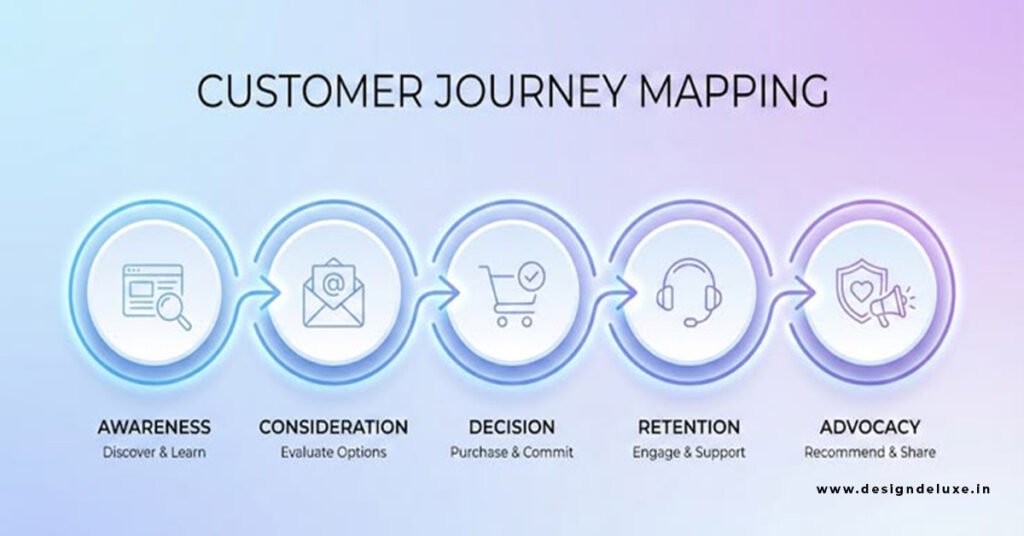
The Core Stages Every Map Should Cover
- Awareness — How do they discover you exist?
- Consideration — What are they comparing you against?
- Decision — What finally tips them toward buying?
- Onboarding/Purchase Experience — How smooth is the actual transaction?
- Retention — Do they come back, or disappear after one purchase?
- Advocacy — Do they tell anyone else about you?
Six stages. Simple on paper. Brutal to actually execute well.
Why Brands Can’t Afford to Skip This in 2026
Customers today compare you against the best experience they’ve ever had anywhere, not just your direct competitors. That’s not a hot take — it’s basically the operating premise behind most modern CX research, including work published by Qualtrics on experience management.
In my experience, companies that skip journey mapping tend to optimize the parts they can see — the homepage, the ad copy — while ignoring the parts customers actually complain about, like a confusing return policy or a support bot that loops forever.
Here’s a sharp question worth sitting with: when was the last time anyone at your company actually experienced your product as a first-time customer would? Not tested it. Experienced it, cold, with no internal context.
If the answer is “never” or “years ago,” that’s your sign.
Customer Journey Mapping for Brands: A Step-by-Step Action Plan
This isn’t theoretical. Here’s the exact sequence I’d run for a brand starting from scratch.
- Pick one customer segment. Not “all customers.” First-time buyers, repeat buyers, and churned customers behave completely differently — map them separately.
- Gather real data, not guesses. Pull support tickets, chat logs, analytics drop-off points, and actual customer interviews.
- List every touchpoint in order. Ads, website, checkout, email, delivery, support — write the whole sequence out, no skipping steps.
- Score each touchpoint for friction and emotion. A simple 1–5 scale works. Where does satisfaction spike? Where does it crater?
- Identify the top 3 pain points. Not ten. Three. Trying to fix everything at once fixes nothing.
- Assign ownership. Friction points usually sit between departments — someone has to own the fix, or it never happens.
- Re-map every 6–12 months. Customer behavior shifts. Your map should too.
Applying a Design Thinking Guide: Problem-Solving for Brands Mindset to Your Map
This is where the two concepts connect directly. A journey map tells you where the problem lives. The empathize-and-define approach from a solid Design Thinking Guide: Problem-Solving for Brands tells you how to actually fix it without guessing.
Map first. Diagnose second. Prototype a fix third. In that order, always.
Answer-Ready Table: Journey Mapping Methods Compared
| Method | Best For | Time Investment | Limitation |
|---|---|---|---|
| Customer Interviews | Deep emotional insight, uncovering “why” | High (days to weeks) | Small sample size, harder to scale |
| Analytics & Funnel Data | Spotting exact drop-off points | Medium (hours to days) | Shows what happened, not why |
| Support Ticket Review | Finding recurring friction and complaints | Low to Medium | Biased toward unhappy customers only |
| Journey Mapping Workshops | Cross-team alignment and shared understanding | Medium (half-day to full-day session) | Relies on internal assumptions if data is thin |
The strongest maps combine at least two of these. Relying on just one method is like diagnosing a car problem by only listening to the engine and never checking the dashboard.
Common Mistakes & How to Fix Them
Mistake 1: Building the map from internal opinion, not real data. Teams sketch a journey based on how they think customers behave. Fix: Pull at least one hard data source — analytics, tickets, or interviews — before drawing a single box.
Mistake 2: Mapping the “ideal” journey instead of the real one. This produces a pretty diagram that’s basically fiction. Fix: Map what actually happens today, friction and all. Fix the ideal version later.
Mistake 3: Making it once and filing it away. A journey map from 2023 tells you nothing useful in 2026. Fix: Set a recurring calendar reminder to revisit it twice a year, minimum.
Mistake 4: Ignoring post-purchase stages. Most maps stop at checkout, as if the relationship ends there. Fix: Extend the map through onboarding, support, renewal, and referral behavior.
Mistake 5: No clear owner for identified problems. A map full of insights with nobody responsible for acting on them. Fix: Assign a name, not a department, to each major friction point before the workshop ends.
Key Takeaways
- Customer journey mapping for brands works best when it’s built on real data, not internal assumptions about customer behavior.
- The six core stages — Awareness, Consideration, Decision, Purchase, Retention, Advocacy — each deserve separate attention.
- Mapping one specific customer segment at a time beats trying to capture “everyone” in a single diagram.
- Friction usually hides in the handoffs between departments, which is exactly why cross-functional buy-in matters.
- Pairing journey mapping with a structured Design Thinking Guide: Problem-Solving for Brands approach turns insight into action instead of just another slide deck.
- Revisit the map regularly — customer behavior in 2026 won’t match behavior from even two years ago.
- Prioritize fixing the top three pain points rather than attempting an overhaul of the entire experience at once.
A journey map isn’t a one-off deliverable you show leadership once and forget. It’s closer to a living health record for your customer relationship — something you check on, not something you frame and hang on the wall. Start with one segment, map the real journey honestly, fix the biggest friction point first, and build the habit of revisiting it. That’s how brands stop guessing and start actually understanding the people paying their bills.
FAQs
How is customer journey mapping for brands different from a sales funnel?
A sales funnel tracks conversion stages toward a purchase. A journey map goes wider — it includes emotions, support interactions, and post-purchase behavior, not just the path to checkout.
What tools do brands typically use to build a customer journey map?
Many start simple with tools like Miro or Figma for visual mapping, then layer in platforms like Salesforce or HubSpot for the underlying customer data once the process matures.
Does customer journey mapping replace the need for a Design Thinking Guide: Problem-Solving for Brands approach?
No — they work together. The journey map identifies where the problem exists, while a structured design thinking approach guides how you actually solve it without just patching symptoms.