Website
Healthcare website accessibility compliance is no longer optional for organizations that serve patients online. In the United States, federal rules now set clear technical standards and deadlines for websites, patient portals, mobile apps, and related digital content. Meeting those standards protects patients, reduces legal risk, and strengthens trust—exactly the outcomes healthcare brands work hard to achieve.
Why Accessibility Matters in Healthcare Digital Experiences
Patients with disabilities must be able to book appointments, view lab results, message providers, pay bills, and access education materials with the same ease as anyone else. When a website or portal fails them, the barrier is more than inconvenient—it can delay care or force patients into less private workarounds.
Federal law recognizes this. Healthcare organizations that receive funding from the Department of Health and Human Services (HHS) fall under Section 504 requirements that explicitly adopt WCAG 2.1 Level AA as the technical standard for web content and mobile apps. Public entities face parallel obligations under ADA Title II. Private providers remain exposed under ADA Title III, where courts and settlement agreements routinely treat WCAG 2.1 AA as the benchmark.
Current Compliance Deadlines and Scope
As of 2026, HHS extended the Section 504 conformance deadlines by one year:
- Organizations with 15 or more employees: May 11, 2027
- Organizations with fewer than 15 employees: May 10, 2028
ADA Title II deadlines for state and local government entities (including many public hospitals and health departments) were similarly extended into 2027 and 2028 depending on population size.
Coverage is broad. It includes:
- Public-facing websites and provider directories
- Patient portals and secure messaging
- Appointment scheduling and telehealth platforms
- Billing and payment systems
- Downloadable documents such as intake forms, consent forms, and educational PDFs
- Mobile apps and many third-party tools used on the organization’s behalf
Exceptions exist for certain archived content, pre-existing conventional electronic documents, and situations that would create an undue burden or fundamental alteration, but these are narrow and must be documented.
Core Technical Requirements: WCAG 2.1 Level AA
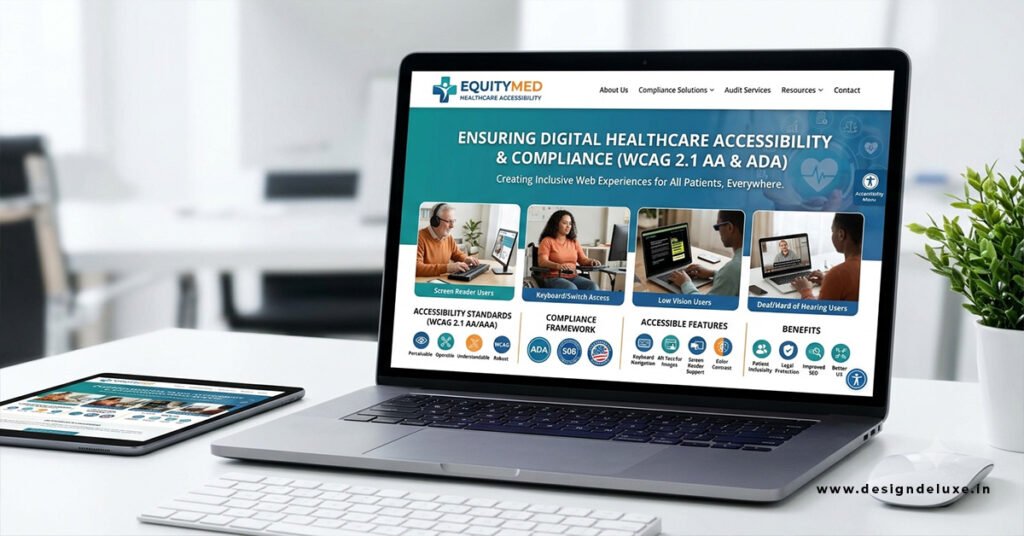
WCAG 2.1 Level AA organizes requirements under four principles: perceivable, operable, understandable, and robust. In healthcare settings the highest-impact failures typically involve:
- Insufficient color contrast (below 4.5:1 for normal text)
- Images and icons missing meaningful alternative text
- Form fields and controls without proper labels or instructions
- Keyboard navigation traps or missing focus indicators
- Videos without accurate captions
- Dynamic content (alerts, results, appointment confirmations) that is not announced to screen readers
Patient portals deserve special attention. Login flows, CAPTCHAs, dashboards, and multi-step forms are frequent sources of barriers. Third-party EHR or scheduling vendors must also meet the same standard when the tools are provided as part of the organization’s services.
Practical Path to Compliance
Most organizations follow a repeatable cycle:
- Inventory all digital properties and third-party tools that patients or the public use.
- Conduct a thorough accessibility audit that combines automated scanning with manual testing (screen readers, keyboard-only navigation, zoom, contrast analysis).
- Prioritize remediation by severity and user impact, starting with critical patient journeys.
- Validate fixes and document conformance (often via a VPAT or Accessibility Conformance Report).
- Establish ongoing monitoring and training so new content and features do not reintroduce barriers.
Accessibility work intersects with other healthcare design priorities. Clear information architecture, readable typography, and consistent visual hierarchy support both usability and compliance. Organizations that already invest in thoughtful visual systems find the path to accessibility smoother. For a broader view of how design choices build patient confidence, see Healthcare Brand Design: Building Trust in Medical.
Common Pitfalls to Avoid
- Treating accessibility as a one-time project instead of an ongoing program.
- Relying solely on automated tools or overlay widgets; these miss many real barriers and do not satisfy legal requirements by themselves.
- Ignoring documents and third-party components.
- Waiting until the deadline approaches. Remediation of complex portals and legacy systems takes months.
- Failing to involve people with disabilities in testing. Real-user feedback reveals issues that technical checks alone overlook.
Benefits Beyond Legal Compliance
Accessible websites expand the reachable patient population, improve overall usability for everyone (including older adults and people using mobile devices in varied conditions), and reduce support calls related to “I can’t find” or “I can’t complete” issues. They also demonstrate a concrete commitment to equity—an increasingly visible part of healthcare brand reputation.
Healthcare website accessibility compliance is both a regulatory requirement and a practical expression of patient-centered care. Organizations that treat it as a core design and engineering responsibility—rather than a last-minute checklist—will meet the coming deadlines with less disruption and deliver better experiences to the people they serve. Start with an honest inventory and a qualified audit; the rest of the work becomes far more manageable once the current state is clear.
Key Takeaways
- Healthcare website accessibility compliance centers on WCAG 2.1 Level AA for websites, patient portals, mobile apps, and related content.
- HHS Section 504 sets deadlines of May 11, 2027 (15+ employees) and May 10, 2028 (smaller organizations) for recipients of federal financial assistance.
- ADA Title II (public entities) and Title III (private providers) also drive accessibility expectations, with WCAG 2.1 AA as the practical benchmark.
- Critical patient journeys—login, scheduling, results, messaging, and billing—require the highest priority testing and remediation.
- Automated tools alone are insufficient; combine them with manual testing using screen readers, keyboard navigation, and real-user feedback.
- Third-party portals, telehealth platforms, and downloadable documents fall within scope and must be addressed.
- Accessibility is an ongoing program, not a one-time project; new content and features need continuous monitoring.
- Meeting the standard expands reach, reduces support burden, and strengthens patient trust.
FAQs
What standard is required for healthcare website accessibility compliance under current HHS rules?
WCAG 2.1 Level AA is the technical standard for websites, web content, and mobile apps of organizations that receive federal financial assistance from HHS.
Do patient portals and third-party tools need to meet healthcare website accessibility compliance requirements?
Yes. Patient portals, appointment systems, telehealth platforms, billing tools, and many vendor-provided applications used on the organization’s behalf are covered and must conform to the same WCAG 2.1 AA criteria.
When are the current deadlines for healthcare website accessibility compliance?
For HHS Section 504, organizations with 15 or more employees have until May 11, 2027; those with fewer than 15 employees have until May 10, 2028. Public entities under ADA Title II face parallel extended deadlines in 2027–2028.