Ad'sBusiness & Finance
Local Google Ads strategies for small businesses are the fastest way to get your phone ringing and your doors swinging from nearby customers who are ready to buy.
No more wasting budget on global reach. These tactics zero in on your neighborhood, your city, or even a 5-mile radius around your store.
The result? Higher-quality leads, lower costs per conversion, and real ROI even on modest budgets.
Here’s what actually works right now:
- Hyper-local targeting that ignores distant browsers.
- Mix of Search, Local Services Ads (LSA), and Display for full-funnel coverage.
- Tight budgets focused on high-intent keywords like “emergency plumber near me.”
- Strong emphasis on Google Business Profile integration and quick response times.
- Visual ads that stop scrolls and drive foot traffic.
Small businesses using these approaches often see 3-5x better lead quality compared to broad campaigns. In competitive local markets, precision beats big spending every time.
Why Local Google Ads Still Crush It for Small Businesses
Big national brands can afford spray-and-pray tactics. You can’t.
Local strategies let you own your backyard. Google’s 2026 algorithms reward businesses that combine accurate location data, fast lead response, and relevant creative.
The kicker? Many small businesses leave money on the table by ignoring Local Services Ads or running sloppy Display campaigns.
This is where visuals become make-or-break. Strong creative directly supports Google Display ad banner design for local small businesses — clean, trustworthy designs that scream “local and reliable.”
Core Local Google Ads Strategies That Work in 2026
Focus on these pillars:
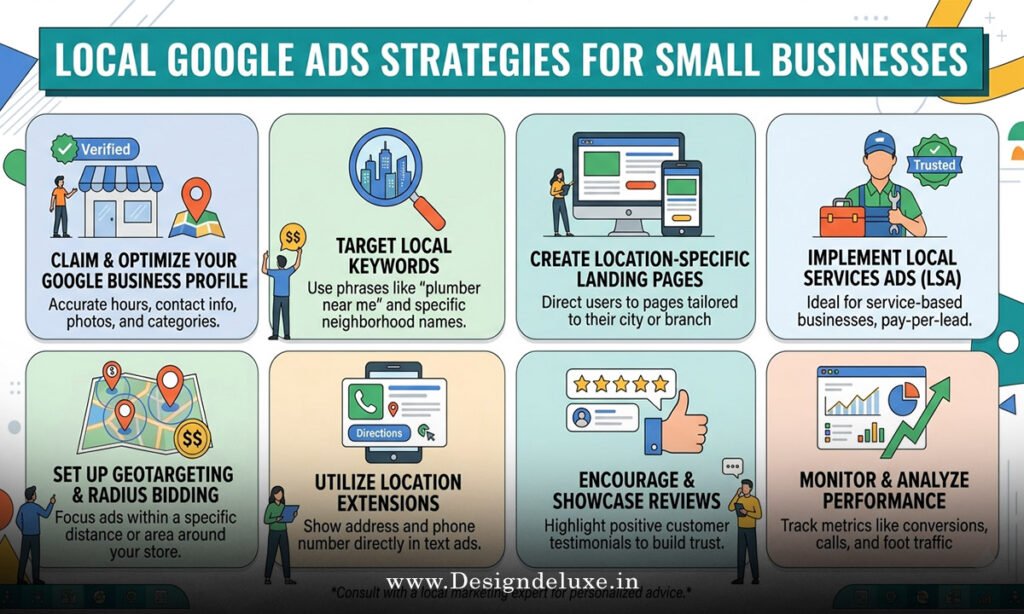
- Hyper-local Search Campaigns: Use exact and phrase match on terms with location modifiers. Set “Presence only” targeting to avoid out-of-area clicks.
- Local Services Ads (LSA): Pay-per-lead model with the coveted Google Guaranteed badge. Perfect for plumbers, electricians, cleaners, and other service pros.
- Responsive Display & Performance Max: Visual ads across the Google network that drive awareness and remarketing.
- Location Extensions & Assets: Show your address, hours, and directions right in the ad.
- Remarketing to Local Audiences: Re-engage people who visited your site or Google Business Profile.
| Strategy | Best For | Typical Monthly Budget | Expected ROI Focus |
|---|---|---|---|
| Local Search | High-intent leads | $500–$2,000 | Calls & bookings |
| Local Services Ads | Service businesses | $300–$1,500 | Qualified leads |
| Google Display | Awareness + remarketing | $400–$1,200 | Traffic & brand recall |
| Performance Max (Local) | Multi-channel reach | $800+ | Overall conversions |
Test one or two at first. Stack them as you prove ROI.
Step-by-Step Action Plan for Beginners
Here’s exactly what I’d do if I were sitting in your office next week:
- Claim and optimize your Google Business Profile — Complete every section, add photos, collect fresh reviews.
- Set up conversion tracking — Phone calls over 30 seconds, form fills, store visits. This is non-negotiable.
- Launch a tight Search campaign — 10-20 high-intent local keywords. Use phrase/exact match and aggressive negative keywords.
- Apply for Local Services Ads (if eligible) — Get verified and start small.
- Create Display campaigns — Focus on compelling banners that match your local vibe.
- Monitor daily for the first two weeks — Adjust bids, pause losers, refine geo-targeting.
- Review weekly — Look at cost-per-lead and lead quality, not just clicks.
Start with a $500–$1,000 monthly test budget. Scale what works.
Common Mistakes & How to Fix Them
Running broad match keywords without negatives is the fastest way to burn cash. Fix: Build a solid negative list from day one.
Ignoring response time kills LSA performance. Leads called within 90 seconds convert far better — automate where possible.
Weak landing pages tank everything. Send traffic to dedicated pages, not your homepage.
Forgetting mobile optimization is deadly. Most local searches happen on phones.
Finally, set-it-and-forget-it syndrome. Local markets shift fast — review performance every week.
Advanced Tactics for Intermediate Users
Layer remarketing with your Google Display ad banner design for local small businesses. Show special offers to people who already visited your site.
Use audience signals in Performance Max for better local targeting. Import offline conversions to train Google’s AI smarter.
Geo-fence tightly around high-value neighborhoods or competitor locations (ethically).
Test video ads and local inventory ads if you have physical products.
Ever wonder why the shop down the street gets steady calls while you struggle? Often it’s not luck — it’s tighter local ad strategy.
One fresh analogy: Local Google Ads are like putting up a bright neon sign on the busiest corner in your town, except this sign follows potential customers around their phones all day.
Key Takeaways
- Local Google Ads strategies for small businesses win through precision, not big budgets.
- Combine Search, LSA, and Display for complete coverage.
- Hyper-local targeting and fast response times are your biggest edges.
- Strong visuals and banner design dramatically boost Display performance.
- Track real conversions, not vanity metrics.
- Test small, measure fast, then double down.
- Integrate everything with your Google Business Profile.
- Consistency beats perfection — keep optimizing weekly.
Local advertising in 2026 still favors the sharp and the responsive. The businesses winning are the ones who show up exactly where their customers are searching.
Your next step: Audit your Google Business Profile today, then set up one focused Search campaign this week. Track results for 14 days and adjust.
FAQs
How much budget do I need for local Google Ads strategies for small businesses?
Start with $500–$1,500 per month. Focus on one or two campaign types first. Many see positive ROI at lower spends when targeting is tight.
Should I use Local Services Ads or regular Google Ads?
Use both if possible. LSAs often deliver higher quality leads for service businesses, while regular Google Ads give more control and broader reach.
How does Google Display ad banner design for local small businesses fit into local strategies?
Eye-catching, locally relevant banners build awareness and remarket to warm audiences. They complement Search and LSA by keeping your brand visible across the web and Maps.