Logo Design
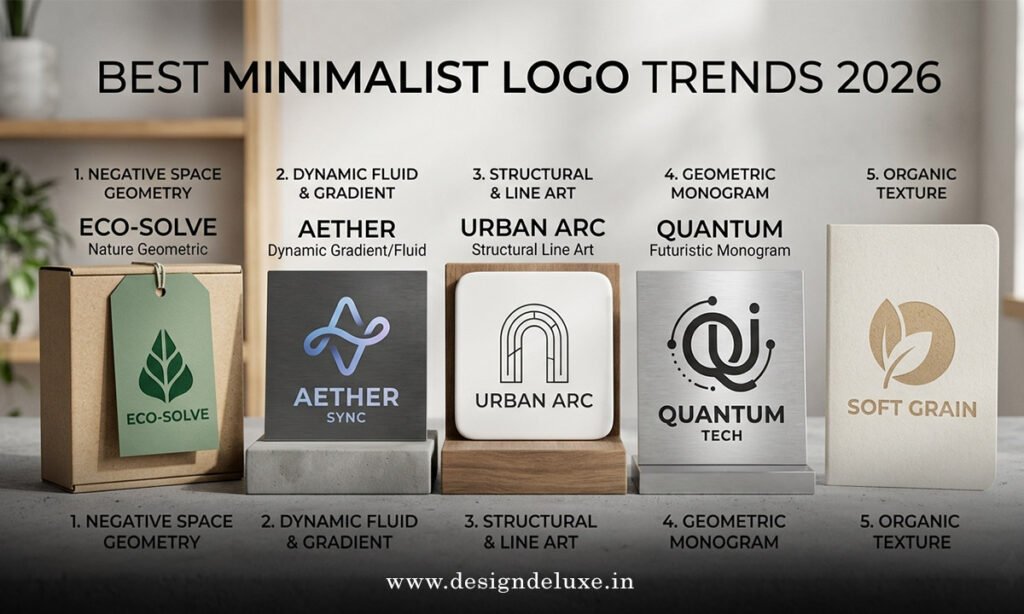
Best minimalist logo trends 2026 put a fresh spin on clean design. Brands ditch cold sterility for warmer, more human versions that still scale beautifully and cut through digital clutter. Small businesses especially love this evolution—it delivers premium impact without complexity or high costs.
- Neo-minimalism adds subtle warmth through soft curves and muted tones.
- Minimalism with a single twist keeps things simple yet memorable.
- Adaptive systems let one core mark flex across every platform and format.
- Micro-details anchor identity without adding noise.
These approaches help new brands stand out fast while staying practical for growth.
Why Best Minimalist Logo Trends 2026 Matter for Small Brands
Clean still wins. But pure stark minimalism feels dated now. Shoppers crave clarity plus connection.
Designers respond with neo-minimalism—less noise, more nuance. Think gentle gradients, organic proportions, and unexpected asymmetry. These elements create emotional pull while keeping files lightweight and versatile.
Small businesses win big here. You get professional polish that works on a $5 sticker or a 10-foot banner. No redesigns every time you add a product line.
The kicker? This style pairs perfectly with minimalist logo design with adaptive packaging for small business 2026. One strong mark flows seamlessly into flexible boxes, pouches, and labels.
Top Minimalist Logo Trends Dominating 2026
Here’s what’s actually moving the needle right now.
Neo-Minimalism: Warmth Without Clutter
Cold geometric perfection? Out. Soft edges and human-friendly proportions? In.
Logos use restrained color palettes—warm neutrals, gentle earth tones—with just enough texture to feel approachable. Negative space gets smarter. One small curve or proportion shift makes the mark yours without sacrificing scalability.
This trend feels luxurious yet accessible. Perfect for wellness brands, craft goods, or boutique services.
Minimalism With a Twist
Start clean. Add one deliberate surprise.
Maybe asymmetric letter spacing. Or a micro-illustration hidden in negative space. A single playful serif in an otherwise sans-serif wordmark.
The twist creates instant recall. Brands remember the quirk, not the generic base. It works especially well for e-commerce where first impressions happen in 0.3 seconds.
Micro-Details as Identity Anchors
Tiny, precise elements carry big meaning. A barely-there gradient. Pixel-perfect alignment. Subtle texture that reveals itself on closer inspection.
These details reward attention without overwhelming small screens. They shine in both digital and print applications.
Adaptive and Dynamic Minimal Marks
Your logo shouldn’t fight the medium. 2026 favors systems that morph intelligently—changing weight, color, or detail level based on context.
A simplified version for favicons. A fuller expression for packaging. Same DNA, different executions. This adaptability saves serious money long-term.
Comparison Table: Minimalist Approaches in 2026
| Trend | Core Strength | Best For | Potential Drawback | Cost Level (Small Biz) |
|---|---|---|---|---|
| Neo-Minimalism | Emotional warmth + clarity | Lifestyle, wellness, retail | Can feel generic if twist is weak | Medium |
| Minimalism with Twist | High memorability | E-commerce, creative services | Twist might not scale well if overdone | Low-Medium |
| Micro-Detail Focus | Premium perceived value | Tech, B2B, luxury goods | Requires precise execution | Medium-High |
| Adaptive Systems | Versatility across platforms | Growing small businesses | Needs upfront planning | Medium (pays off fast) |
Step-by-Step: Building Your 2026 Minimalist Logo
Don’t guess. Follow this flow.
- Distill your brand. One word. One feeling. Write it down. Everything else supports that core.
- Sketch raw. Black and white first. Test at tiny sizes. If it disappears, start over.
- Introduce the twist early. Decide on your one unexpected element. Bake it into initial concepts.
- Build variants. Create full color, monochrome, stacked, horizontal, icon-only versions.
- Test adaptability. Shrink it. Put it on curved surfaces. Check mobile. Print samples.
- Lock guidelines. Document clear space, minimum sizes, color codes. This prevents future chaos.
- Integrate with packaging. Ensure the mark works on your actual boxes and labels from day one.
What usually happens is owners fall in love with screen versions and get surprised by real-world performance. Print early. Always.
Common Mistakes & How to Fix Them
Mistake 1: Going too safe. Result? Forgettable blob.
Fix: Force one deliberate imperfection or twist during sketching.
Mistake 2: Ignoring scalability. Beautiful on desktop, useless on packaging.
Fix: Design for the smallest use case first.
Mistake 3: Trend chasing without strategy. Neo-minimalism looks great until it doesn’t match your voice.
Fix: Tie every decision back to your core brand word.
Mistake 4: Static thinking. One fixed logo in a multi-channel world.
Fix: Build a small system of variants from the beginning.
Practical Tips for Implementation
Focus on vector perfection. Every curve must stay crisp at any size.
Warm neutrals work better than pure black and white for emotional connection. Test on different backgrounds—your logo will live on many.
Pair your new mark with smart packaging choices. The clean aesthetic amplifies quality perception when materials feel substantial.
For deeper implementation, check how these trends combine with real-world execution in minimalist logo design with adaptive packaging for small business 2026.
Explore more inspiration through Shopify’s 2026 logo trends overview.
Or dive into practical examples at Digital Synopsis logo trends report.
Key Takeaways
- Best minimalist logo trends 2026 favor warmth and personality over sterile simplicity.
- One strong twist beats decorative overload every time.
- Adaptive thinking saves money and headaches as you grow.
- Micro-details create premium feel without complexity.
- Test in real contexts—not just on screen.
- Neo-minimalism pairs beautifully with sustainable packaging.
- Simplicity done right builds instant trust.
- Start with strategy, not software.
The brands winning in 2026 treat minimalism as a foundation for connection, not an end goal.
Grab your sketchbook. Pick your core feeling. Add one meaningful twist. Build from there. Your customers will feel the difference immediately.
FAQs
How do best minimalist logo trends 2026 differ from previous years?
They emphasize warmth, subtle personality, and adaptability instead of pure cold geometry. Neo-minimalism adds emotional layers while keeping the clean power intact.
Are these trends suitable for very small businesses on tight budgets?
Yes. Many can be executed with tools like Figma or Canva plus smart freelancer help. Focus on one strong mark and adaptive rules rather than multiple complex assets.
Should I combine best minimalist logo trends 2026 with adaptive packaging?
Strongly recommended. The clean aesthetic shines when your entire brand system—including packaging—stays consistent and flexible.