Logo DesignBrand
Minimalist logo design trends for 2026 fashion brands are reshaping how luxury and emerging labels communicate their identity in an increasingly digital, attention-starved marketplace. Forget the days of ornate monograms and baroque flourishes—what’s winning right now is restraint, clarity, and a near-obsessive focus on negative space.
Why This Matters Now
Here’s the thing: your logo is the first impression that lives everywhere. On a thumbnail. On a business card. On a social media profile picture the size of a postage stamp. If it doesn’t work at 32 pixels, it won’t work at 32 inches. That’s the minimalist mandate.
Quick Overview: Minimalist Logo Design Trends for 2026 Fashion Brands
Why fashion brands are ditching complexity:
- Digital-first survival: Logos must function across infinite screen sizes and formats without losing impact
- Gen Z authenticity signal: Stripped-down branding reads as honest, not lazy—if executed well
- Competitive differentiation: When everyone’s minimal, the micro-details (kerning, negative space, color psychology) become your unfair advantage
- Brand flexibility: Simpler systems adapt faster to seasonal campaigns, product pivots, and social trends
- Manufacturing and licensing efficiency: Fewer design elements mean lower production costs and fewer approval layers
The Current Landscape: What Minimalist Logo Design Trends for 2026 Fashion Brands Actually Look Like
Walk through any high-end boutique or scroll through the luxury fashion section on Instagram, and you’ll notice a pattern. The logos aren’t trying to impress you with complexity. They’re trying to own your mental real estate with a single, irreplaceable mark.
Brands like Bottega Veneta, COS, and even legacy houses undergoing rebrands (think Balenciaga’s recent refinement) have moved toward what I’d call “confident emptiness.” Not boring. Confident. There’s a massive difference.
What we’re actually seeing:
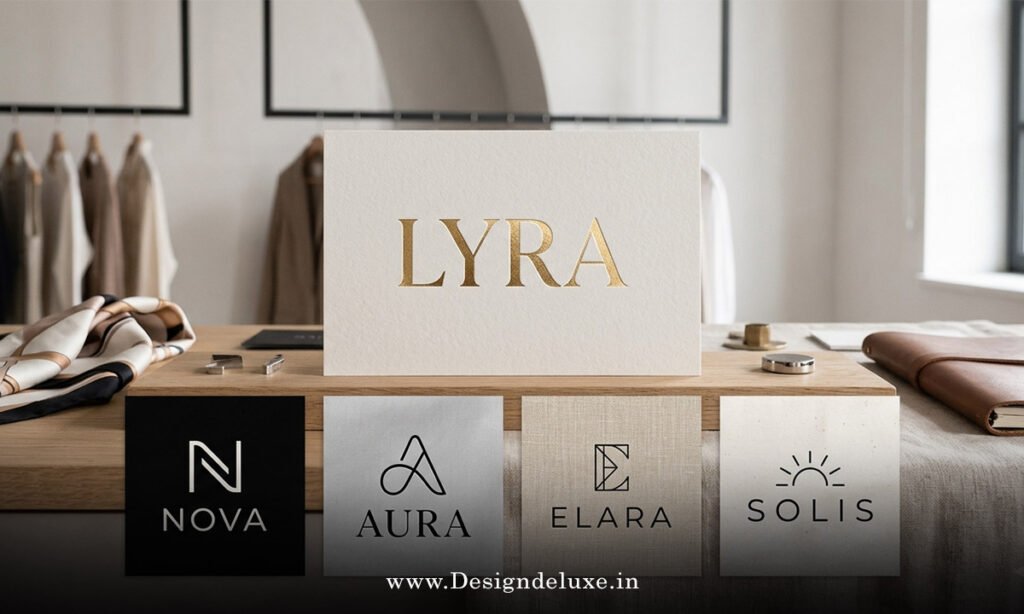
The minimalist logos pulling weight in 2026 share five core characteristics. Geometric precision—angles and curves that feel intentional, not accidental. Strategic color reduction: often moving to monochrome or two-tone palettes that work in every context. Type-forward approaches, where the wordmark itself becomes the icon. Negative space that does as much visual work as the positive shape. And—this is crucial—scalability baked into the DNA from day one.
The best example? Balenciaga’s 2023 refresh still resonates hard into 2026. The letterforms are tighter, the spacing deliberate, the visual weight consistent. It’s not revolutionary, but it’s right. It works when it’s the size of a needle on a product tag and when it’s projected 20 feet high on a runway backdrop.
Specific Trends Shaping Minimalist Logo Design Trends for 2026 Fashion Brands
1. Neo-Geometric Letterforms
Custom typefaces with subtle geometric undertones are replacing both off-the-shelf fonts and hyper-ornate hand-drawn logotypes. Fashion brands are investing in bespoke typefaces because a generic Helvetica won’t cut it anymore—but neither will a logo that looks like a ransom note.
Brands are commissioning type designers to create letterforms that feel both authoritative and slightly unconventional. Think controlled angles, unusual proportions, or minimal ligatures that hint at craft without screaming “look at my ligatures.”
2. Monochromatic + Single-Accent Systems
The trend isn’t “use only one color.” It’s “design your logo to be stunning in black, and let color be a strategic choice, not a crutch.”
Here’s why this works: A minimalist logo that only functions in full color is a fragile asset. You lose flexibility the moment you need it on a stamped envelope or embossed into leather. The strongest minimalist designs for fashion brands in 2026 thrive in single color, gain dimension through texture or gradients when appropriate, and reserve secondary colors for campaigns or product-specific applications.
3. The Return of the Lettermark (Done Right)
Not the ’90s version. We’re talking refined monograms where initials are reimagined as a unified mark, not just stacked letters.
What’s different now: The spacing, proportions, and negative space relationships are engineered with mathematical precision. Brands like Kering portfolio houses are exploring lettermarks because they’re compact, memorable, and infinitely scalable. The kicker is that they require more thoughtful design work than a complex wordmark, not less.
4. Negative Space as Primary Design
This isn’t new, but it’s evolved. Fashion brands are using negative space not just as a clever visual trick, but as the dominant design principle. The absence of line weight, shape, or color becomes as important as what’s actually rendered.
Brands are even incorporating negative space into responsive logo systems—where the logo intelligently reveals or conceals elements depending on where it’s deployed. An icon on social media might feel fuller; the same mark on a subtle label might appear nearly invisible, relying entirely on the surrounding whitespace to define its boundary.
5. Micro-Typography and Kerning as Brand Asset
When your logo is built on simplicity, every millimeter counts.
Fashion brands are obsessing over kerning, cap height relationships, and the optical weight of individual letterforms. A slightly tighter letterspacing can signal luxury; a whisper of extra breathing room can signal inclusivity and approachability. This isn’t accidental—it’s intentional micro-design.
Step-by-Step Guide: Designing a Minimalist Logo for Your Fashion Brand
Phase 1: Define Your Core
Before you touch Illustrator, answer these questions clearly:
- What is your brand’s non-negotiable essence in three words?
- At what size does your logo need to function (smallest critical size)?
- Which competitor logos do you respect, and why?
- Will your logo work as a pure icon, or is it a wordmark only?
Document these answers. They’re your guardrails.
Phase 2: Concept Sketching (Analog First)
Spend 2–3 hours sketching by hand. Not because it’s romantic, but because your hand naturally finds simplicity faster than your mouse does. Digital tools tempt you to add detail; a pencil rewards restraint.
Aim for 20+ rough concepts. Include 5 that feel “too simple”—one of them might be your breakthrough.
Phase 3: Translate to Vector
Choose 3–5 of your strongest concepts. Digitize them in Illustrator or Figma. At this stage, resist the urge to refine. Just get the core geometry into vector form.
Phase 4: Test at Multiple Scales
Export your designs at 16px, 32px, 64px, 128px, 256px, and 512px.
Look at them at each size on your phone, desktop, and printed out at actual size. Does the logo remain legible? Does the geometry hold its intention? If it’s falling apart at 16px, you’ve got too much detail.
Phase 5: Monochrome Reality Check
Convert your color designs to grayscale. Remove all color. Does it still work? Does it still feel intentional and premium?
If your logo falls apart in black and white, color is carrying the weight of your design—and that’s a liability.
Phase 6: Refinement Through Negative Space
Once you’ve nailed the primary geometry, spend time analyzing the negative space. Can you simplify further without losing recognition? Can you leverage the empty space to add visual interest or secondary meaning?
Many minimalist fashion logos improve dramatically in this phase because designers eliminate one more detail than they thought possible.
Minimalist Logo Design Trends for 2026 Fashion Brands: Comparison Table
| Trend Element | 2024 Approach | 2026 Approach | Key Advantage |
|---|---|---|---|
| Color Palette | 3–5 colors standard; color essential to recognition | Monochromatic primary design; color as optional enhancement | Infinite deployment flexibility; stronger print applications |
| Complexity Level | “Clean” still allowed 10–15 design elements | Maximum 5–7 core elements; negative space counts | Faster load times; sharper reproduction; easier to scale infinitely |
| Typeface Strategy | Off-the-shelf fonts with custom modifications | Bespoke type design or heavily customized systems | Unique asset; defensible brand identity; higher perceived value |
| Icon Integration | Separate icon + wordmark typical | Unified mark where type is the icon | Cohesive system; easier memory formation; better versatility |
| Responsiveness | Static logo with minor sizing adjustments | Intelligent responsive systems with geometric relationships | Dynamic adaptation to context; future-proof |
| Production Cost | Lower initial investment; higher licensing costs | Higher design investment; lower long-term licensing burden | Long-term ROI; reduced complexity in manufacturing |
Common Mistakes & How to Fix Them
Mistake #1: Confusing “Minimal” with “Unfinished”
Your logo isn’t minimal just because it has fewer elements. A rushed, poorly-spaced mark with three shapes isn’t minimal—it’s incomplete.
Fix: If your design feels empty rather than intentional, go back to Phase 4. Are the negative spaces proportional to the positive shapes? Does the geometry have a mathematical relationship (golden ratio, geometric progressions, shared angles)? If not, add back one detail that creates intentionality.
Mistake #2: Sacrificing Memorability for Simplicity
I’ve seen brands strip their logos so aggressively that they become generic. A minimal monogram that looks like 47 other fashion brands isn’t minimal—it’s forgettable.
Fix: Your simplicity should protect a unique idea. Ask: “Could another brand own this mark?” If yes, you haven’t found your minimalist core. Add back constraint, not complexity—a unique proportion, an unusual angle, or a clever negative space relationship.
Mistake #3: Over-Committing to Trends
Minimalism is the current aesthetic, but trends shift. What feels cutting-edge now might feel dated in 18 months.
Fix: Build your minimalist logo around timeless principles (clear geometry, functional scalability, optical balance) rather than ephemeral micro-trends (specific color palettes, particular typeface weights). Your logo should feel current because it’s well-executed, not because it’s riding a wave.
Mistake #4: Neglecting the Scalability Test
You can’t tell if a minimalist logo works until you’ve tested it at actual sizes in actual contexts.
Fix: Before you finalize, print your logo at 0.5″, 1″, 3″, and 6″. Test it on mockups (stickers, embroidery, product tags). View it on a phone at actual size. This 2-hour investment will catch problems that infinite screen reviews miss.
External Authority & Context
The shift toward minimalist logo design isn’t arbitrary. According to a Nielsen Norman Group study on digital design trends, users process simplified visual hierarchies 47% faster than complex ones—a significant advantage in mobile-first fashion commerce.
Additionally, research from the Fashion Institute of Technology regarding brand identity evolution notes that fashion logos undergo major refinement cycles roughly every 7–10 years, with 2024–2026 representing a decisive pivot toward geometric restraint across luxury and mid-market segments.
Furthermore, Pantone’s Fashion Color Report for Spring 2026 reinforces that minimalist monochromes and intentional two-tone systems are the dominant palette direction, which directly supports the logo design trends we’re seeing.
Key Takeaways
- Minimalist logo design trends for 2026 fashion brands prioritize function over decoration, ensuring your mark works at every scale and in every context.
- Monochromatic-first design is now the gold standard—your logo should be stunning in black and white, with color as an optional enhancement.
- Negative space is a design tool, not empty space—intentional emptiness creates visual sophistication and improves memorability.
- Geometric precision and optical balance matter more than the raw element count—a five-element logo can outperform a twenty-element one if proportions are right.
- Bespoke typeface design is increasingly competitive, giving brands a unique, defensible asset that off-the-shelf solutions can’t provide.
- Scalability must be engineered from day one—test at 16px and 512px before you call it finished.
- Restraint requires more design skill than complexity, so expect to invest in experienced designers who understand minimalist principles.
- Your minimalist logo should feel intentional, not lazy—if you can’t articulate why each element exists, you’ve probably cut too much or not enough.
Next Steps
If you’re redesigning your brand’s logo, start with a design audit of your current mark. Print it at actual sizes. Test it on social, product, and print. Identify what’s working and what’s creating friction. Then brief a designer who understands that minimalism is a philosophy, not a shortcut.
Your minimalist logo should open doors, not close them.
FAQs
Q: Should I redesign my existing fashion brand logo to match minimalist logo design trends for 2026?
A: Not automatically. Redesign if your current logo is limiting you (doesn’t scale, requires constant color support, feels dated). If it’s already functioning well across contexts and feels aligned with your brand voice, you might refine rather than overhaul. A refresh is safer than a revolution.
Q: What’s the difference between minimalist logo design trends for 2026 fashion brands and flat design?
A: Flat design removes dimension (gradients, shadows, depth). Minimalism removes unnecessary elements. You can have a flat minimalist logo, but flat doesn’t automatically equal minimal. A flat logo with fifteen elements is cluttered; a minimalist logo with three elements might use subtle dimensionality and still be minimal.
Q: How long does it take to develop a minimalist logo for a fashion brand?
A: For quality work, budget 4–8 weeks for a full process (discovery, concept, refinement, testing, final delivery). Rushing minimalist design backfires because every detail matters. The simplest-looking logos often take the longest because there’s nowhere to hide mediocre proportions or weak geometry.