Brand PackagingDESIGNEco-Friendly / Sustainable
Eco friendly packaging design and branding for sustainable products is no longer a marketing nice-to-have—it’s table stakes. Your box, bag, or bottle is now the first handshake between your brand and a customer who is actively judging your values before they even read your label.
Here’s what you need to know right now:
- It’s a trust signal, not just a container. According to a 2025 survey of 1,000 U.S. adults by UPrinting, 77% of consumers say they trust a brand more when its packaging appears eco-friendly.
- Buying behavior has already shifted. 68% of U.S. consumers have changed their shopping habits specifically to reduce plastic waste.
- Recyclability rules the conversation. McKinsey’s 2025 U.S. consumer survey found 77% of U.S. shoppers rank recyclability as “extremely” or “very important” in packaging.
- The market is enormous and growing. The U.S. sustainable packaging market is projected to expand from $51.23 billion in 2025 to $73.81 billion by 2034.
- Legislation is forcing the issue. Extended Producer Responsibility (EPR) laws are now active in six U.S. states, with more on the way.
Why Eco Friendly Packaging Design and Branding for Sustainable Products Actually Moves the Needle
Think of your packaging like a storefront window. You get maybe three seconds of eye contact before someone decides to walk in or keep walking. That window is now communicating environmental values whether you designed it that way or not.
The kicker is this: 93% of U.S. consumers in that same UPrinting survey said they’d choose the more sustainable-looking product when prices are equal. Equal price, visual design wins. That’s not a niche result—that’s a majority decision made in the aisle.
And it’s not just optics. 49% of parents now associate eco-friendly packaging with higher product quality. The definition of “premium” has quietly migrated away from glossy plastic clamshells and toward kraft paper, clean typography, and honest, minimal labeling. If your brand plays in the health, beauty, food, or lifestyle space, you’re already operating in the category where this shift is most acute.
So why do so many brands still get this wrong?
The Core Materials: Know What You’re Working With
Before you design anything, you need to know your material options. Not all “green” materials are created equal—and greenwashing is the fastest way to lose the exact customers you’re trying to attract.
| Material | Key Benefit | Best Use Case | Recyclability (USA) | Watch Out For |
|---|---|---|---|---|
| Recycled Cardboard/Kraft Paper | Widely available, low cost, familiar to consumers | Boxes, mailers, hang tags | High — widely accepted curbside | Moisture sensitivity |
| Post-Consumer Recycled (PCR) Plastic | Reduces virgin plastic demand | Bottles, pouches, wraps | Moderate — depends on resin type | Inconsistent quality supply |
| Glass | Perceived as most sustainable by U.S. consumers | Beverages, cosmetics, food jars | High — strong curbside acceptance | Weight increases shipping costs |
| Compostable PLA (plant-based) | Biodegradable in certified facilities | Food service, inner liners | Low — needs industrial composting | Consumer confusion over disposal |
| Molded Fiber / Pulp | Fully biodegradable, premium unboxing feel | Electronics, cosmetics, eggs | High | Higher upfront tooling cost |
| Mushroom Packaging (mycelium) | 100% compostable, customizable shape | Protective void fill | High (home compostable) | Limited scalability, cost |
Step-by-Step Action Plan: Building Your Eco Friendly Packaging Design and Branding for Sustainable Products from Scratch
This is the process I’d walk through if I were launching a product line today. Start here, stay in order.
1. Audit your current packaging footprint
Before you redesign anything, document exactly what you’re using. Weight, material composition, supplier country of origin, disposal pathway. You can’t improve what you haven’t measured.
2. Define your sustainability claim clearly
Decide before design what your actual claim will be: recyclable, made from recycled content, compostable, reduced plastic, or all of the above. Vague claims like “eco-conscious” won’t survive FTC scrutiny under the Green Guides, and savvy consumers will smell the greenwash immediately.
3. Choose your primary material
Start with one change, not five. If you’re on a tight budget, swapping to recycled cardboard and eliminating unnecessary inner plastic is the highest-ROI first move. If you’re in beauty or food, glass or PCR plastic gets you the strongest consumer trust signal.
4. Design with the “less is more” principle
Minimalism isn’t just trendy—it literally reduces material use. Eliminate inserts that serve no functional purpose. Right-size your boxes. According to the Sustainable Packaging Coalition’s 2025 Trends Report, 37% of brand owners are now prioritizing lightweighting and rightsizing as top sustainability demands—up sharply from prior years.
5. Build your visual brand language around honesty
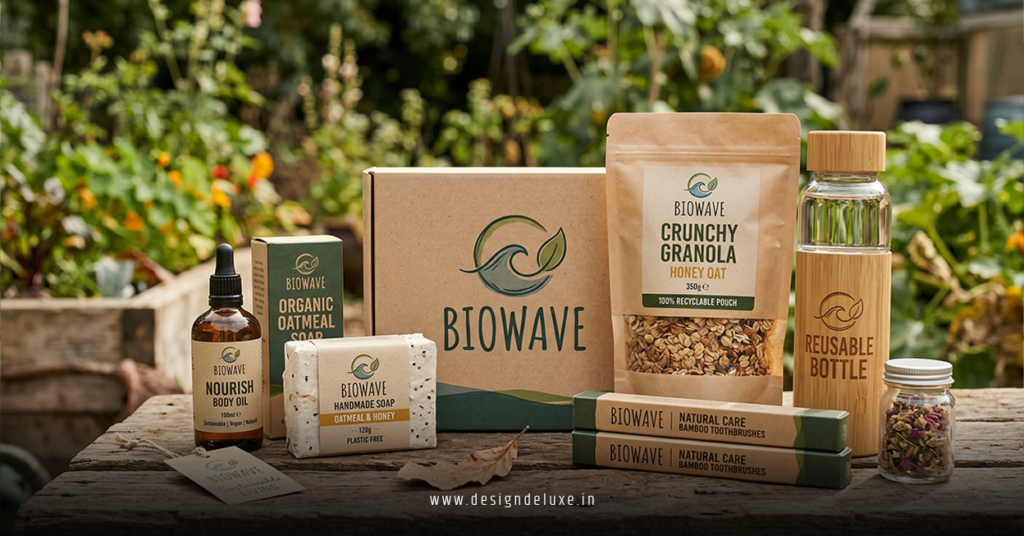
Use natural color palettes—earthy browns, forest greens, off-whites. Choose typography that reads clean and confident. Your icons and certifications (FSC, How2Recycle, Rainforest Alliance) should be prominent and legible, not buried in fine print.
6. Write disposal instructions directly on the packaging
This is underrated. 71% of global consumers say they want brands to be more transparent about packaging materials. Tell your customer exactly what to do with the package when they’re done. One clear sentence. No fine print.
7. Test before you scale
Order a small run. Put it through your actual supply chain—warehouse drops, shipping vibration, moisture exposure. Sustainable materials sometimes behave differently under logistics stress. Find out on 500 units, not 50,000.
8. Communicate the story, not just the spec
Your website, your social media, and your packaging copy should tell customers why you made these choices—and what the real-world impact is. “This box is made from 80% post-consumer recycled content, saving approximately X lbs of virgin material per order” is compelling. “Eco-friendly packaging” is not.
Common Mistakes in Eco Friendly Packaging Design and Branding for Sustainable Products (And How to Fix Them)
Mistake 1: Greenwashing with vague claims
What it looks like: Slapping a leaf icon on your box and calling it “sustainable.” No certifications. No specifics.
The fix: Make only claims you can substantiate. Use third-party certifications where possible. The FTC’s Green Guides set the legal standard in the U.S., and regulators are increasingly active.
Mistake 2: Choosing materials your customers can’t actually recycle
What it looks like: Launching compostable packaging without realizing that less than 10% of U.S. consumers have access to industrial composting facilities.
The fix: Check disposal infrastructure by region. If you ship nationally, lean on curbside-recyclable materials first. Compostable options are great for local or direct-to-consumer brands where you can guide the end-of-life story directly.
Mistake 3: Making sustainability the only brand message
What it looks like: Every inch of packaging screams “green” but says nothing about what the product actually does or why it’s worth buying.
The fix: Sustainability enhances your brand—it doesn’t replace it. Your eco credentials should sit alongside your quality story, not replace it. Remember, McKinsey’s research consistently shows price and quality outrank environmental factors in purchase decisions. Lead with what you do best; let the green story reinforce it.
Mistake 4: Ignoring the unboxing experience
What it looks like: Technically sustainable packaging that looks and feels cheap, making customers question the product quality inside.
The fix: Texture, structure, and weight all communicate value. Molded pulp, matte coatings, debossing, and quality kraft can feel genuinely premium. The Dieline is an excellent resource for seeing how leading brands are solving this exact tension.
Mistake 5: Redesigning everything at once
What it looks like: A brand overhaul that blows the budget and creates supply chain chaos.
The fix: Prioritize. One SKU, one material change, one run. Prove the business case, then scale.
Eco Friendly Packaging Design and Branding for Sustainable Products: The Regulatory Layer You Can’t Ignore
This part trips up a lot of small and mid-size brands. EPR laws are now live in six U.S. states, with more state legislatures actively debating their own versions. California and Maine are furthest along. What this means practically is that brands selling in those states may face fees, reporting requirements, or material restrictions tied directly to their packaging choices.
The FTC Green Guides—which govern what you can and cannot claim on packaging in the U.S.—are also under review. Keeping your claims specific, substantiated, and auditable isn’t just ethical. It’s legally prudent.
Key Takeaways
- Packaging is a brand signal. 77% of U.S. consumers say eco-friendly-looking packaging builds trust before a word of copy is read.
- Recyclability is your baseline. U.S. consumers rank recyclability as the most important sustainability factor in packaging—prioritize curbside-recyclable materials first.
- Design communicates values instantly. Minimalist, honest, well-labeled packaging out-performs loud “green” claims every time.
- Greenwashing is a brand liability. Vague eco claims expose you to FTC scrutiny and consumer backlash; be specific or be quiet.
- Legislation is accelerating. EPR laws in six U.S. states mean compliance isn’t optional for brands operating at scale.
- Start small, measure, scale. One material change done well beats a full redesign done poorly.
- Tell the disposal story. Clear, prominent end-of-life instructions are the single most underused tool in sustainable packaging communication.
- Premium perception has shifted. Restraint, natural materials, and clean design now signal quality to nearly half of U.S. shoppers.
The brands winning this right now aren’t the ones with the greenest supply chain on paper. They’re the ones whose packaging looks and feels honest—like a brand that has genuinely done the work. That’s the bar. Build to it.
Frequently Asked Questions
Q1: What’s the most cost-effective first step in eco friendly packaging design and branding for sustainable products for a small business?
Start with a material swap on your highest-volume SKU. Replacing virgin cardboard with recycled kraft board and eliminating non-functional plastic inserts typically delivers the biggest environmental improvement for the lowest incremental cost. You don’t need to redesign your brand identity—just upgrade the substrate and add a clear recyclability message.
Q2: How do I avoid greenwashing when building eco friendly packaging design and branding for sustainable products?
Only make claims you can back up with documentation. Use recognized third-party certifications like FSC (for paper/cardboard), How2Recycle (for recyclable materials), or BPI (for compostables). The FTC’s Green Guides provide the U.S. legal framework for what environmental claims are and aren’t permissible—read the summary before you finalize any packaging copy.
Q3: Does sustainable packaging actually affect sales, or is it mostly a PR move?
The data says both. In a 2025 UPrinting survey of 1,000 U.S. adults, 93% said they’d choose a more sustainable-looking product when price is equal, and 32% said they’d pay 6–10% more for sustainably packaged products. That’s a real commercial premium. But the bigger long-term play is retention—53% of Gen Z consumers have already stopped buying from brands that use excessive plastic. Sustainable packaging is increasingly the cost of keeping those customers, not just attracting them.