Business & Finance
How to write a positioning statement is the question most founders ask right after they pick a name and before they touch a logo, and the answer fits in a single sentence. Getting that sentence right takes a bit more work.
Quick overview
- What it is: A positioning statement is an internal one-to-two sentence summary of who you serve, what you offer, and why you’re the better choice.
- Why it matters: It filters every decision about messaging, pricing, design, and where you show up.
- The formula: Audience, problem, category, key benefit, proof.
- Who sees it: Your team and your freelancers. Customers see the results, not the sentence.
- How long it takes: One focused hour for a draft, plus a few days of testing.
This guide is part of our wider series on brand building. If you’re still mapping the big picture, start with Branding Basics: Complete Guide for New Entrepreneurs, then come back here for the deep dive on positioning.
What a Positioning Statement Actually Is
A positioning statement is a decision, written down.
It names the customer you’re built for, the problem you solve, the category you compete in, and the reason you’re a better fit than the alternatives. That’s it. It isn’t a slogan, and it isn’t meant for your website’s homepage.
Think of it like a seating chart at a wedding. You can’t put everyone at the head table. Positioning decides who sits with you, who sits across the room, and which relatives you’re politely steering away from. Customers do the same thing in their heads, so you may as well influence where you land.
Here’s the thing most beginners miss: the statement is private. Its job is to make your public-facing work sharper. Your tagline, your homepage headline, and your sales emails all grow out of it.
Positioning Statement vs. Similar Brand Documents
Founders mix these up constantly. Here’s how they differ.
| Document | Purpose | Audience | Typical Length |
|---|---|---|---|
| Positioning statement | Guides strategic and creative decisions | Internal team and partners | 1–2 sentences |
| Value proposition | Explains the benefit to customers | Prospects and customers | 1 headline plus support |
| Mission statement | Describes why the company exists | Team, investors, public | 1–2 sentences |
| Tagline | Creates a memorable hook | General public | 3–8 words |
| Elevator pitch | Explains what you do in conversation | Anyone you meet | 20–30 seconds spoken |
Why Knowing How to Write a Positioning Statement Pays Off
Without one, every choice becomes a debate. Should the website sound playful or serious? Should you chase the premium buyer or the budget buyer? Which social platform deserves your limited hours?
With one, you check the sentence and the answer shows up.
It also protects you from drifting. In my experience, small businesses rarely fail from one bad decision. They fail from fifty slightly inconsistent ones that leave customers unsure what the business stands for.
And it makes hiring help cheaper. Hand a designer or copywriter a clear positioning statement and you skip rounds of revisions.
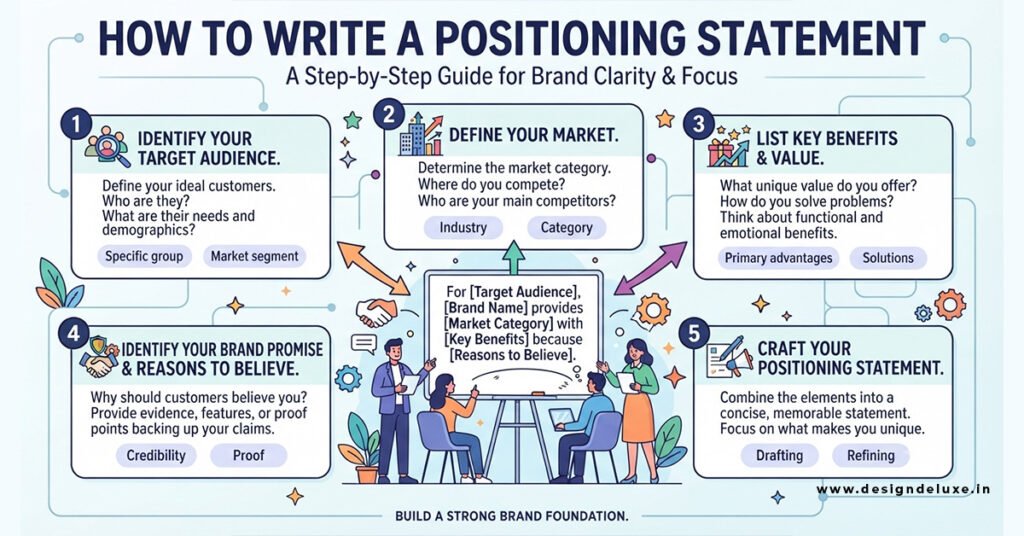
The Positioning Statement Formula
Most strong statements use some version of this template:
For [target audience] who [need or problem], [brand] is the [category] that [key benefit], because [proof or reason to believe].
A hypothetical example:
For first-year freelance bookkeepers who dread chasing invoices, LedgerLoop is the invoicing tool that gets clients paid in days instead of weeks, because it automates reminders in a friendly, human tone.
Notice what’s missing: buzzwords. No “innovative,” no “best-in-class,” no “solutions.” Every piece is specific enough that a competitor couldn’t copy and paste it.
How to Write a Positioning Statement: Step-by-Step
Here’s what I’d do if I were starting from a blank page. Follow the order.
Step 1: Define Your Target Customer in Plain Language
“Small business owners” is too broad to help you. Get narrower. Who exactly has this problem most painfully?
Write down their role, situation, and frustration. If you’ve talked to even five real prospects, use their words. Direct quotes from customer conversations beat your own assumptions every time.
Step 2: Name the Problem or Need
What are they trying to fix, and what happens if they don’t? Describe the pain from their side, not the feature list from yours.
A useful test: could your customer read that line and say, “Yes, that’s exactly it”? If not, rewrite.
Step 3: Choose Your Category
Pick the frame of reference customers already use. “Accounting software,” “meal-prep service,” and “local landscaping company” tell people instantly where to file you.
Resist the urge to invent a category. Unless you have a big budget to educate the market, borrow a familiar one and differentiate inside it.
Step 4: Pinpoint Your Differentiator
This is the hard part, and it’s where most drafts go soft. What do you do that alternatives don’t, or do noticeably better?
To find it, map your top three competitors. The U.S. Small Business Administration’s market research and competitive analysis guide walks through how to study your market and competitors with free tools. Look for the gap nobody is filling. That gap is your opening.
Step 5: Add Proof You Can Back Up
A benefit without evidence is just a claim. Your proof might be a process, a guarantee, a credential, a specific feature, or early customer results.
Be careful here. Advertising claims need to be truthful and supportable, and the Federal Trade Commission’s advertising and marketing guidance for businesses is a good reference. If you can’t substantiate it, leave it out of the statement.
Step 6: Draft the Sentence, Then Cut It
Plug your answers into the formula. Write it ugly first. Then trim every word that doesn’t carry weight.
Read it out loud. If you stumble, your customers will too.
Step 7: Test It Against Reality
Show the statement to five people in your target audience. Ask them to describe your business back to you in their own words. If their version drifts far from yours, you have a clarity problem, not a wording problem.
Also check that the name and visuals you plan to use don’t clash with existing marks. The USPTO’s trademark information page explains how to search for conflicts before you commit.
Positioning Statement Examples You Can Adapt
Same formula, different businesses. These are fictional, so use them as models rather than copy-ready text.
Local service business:
For busy homeowners in suburban Ohio who are tired of unreliable lawn crews, GreenLine Yards is the lawn care company that shows up on schedule every week, because every visit is tracked and confirmed by text.
Online product:
For new parents who struggle to cook after long days, PrepPail is the meal-prep subscription that delivers 20-minute dinners with one-pan instructions, because every recipe is tested by working parents.
Consulting practice:
For early-stage SaaS founders who can’t afford a full-time marketer, Northbeam Advisory is the fractional marketing partner that builds a repeatable lead engine in 90 days, because we run a fixed-scope playbook instead of open-ended retainers.
Each one picks a side. That’s the point. A statement that tries to please everyone ends up pleasing nobody.
Common Positioning Statement Mistakes and How to Fix Them
I’ve reviewed plenty of these over the years, and the same problems show up again and again.
Mistake 1: Targeting everyone.
Fix: Narrow to the group that feels the pain most. You can widen later.
Mistake 2: Stuffing in jargon.
Fix: Replace buzzwords with something concrete. If a stranger can’t repeat it, it’s not working.
Mistake 3: Listing features instead of benefits.
Fix: Ask “so what?” after every feature until you reach something the customer cares about.
Mistake 4: Skipping the competition.
Fix: Study alternatives before you write. What usually happens is founders discover their “unique” angle is already taken.
Mistake 5: Writing it once and filing it away.
Fix: Revisit it every six months or when your offer, audience, or market shifts.
Mistake 6: Confusing it with a tagline.
Fix: Keep the statement internal and functional. Let your copywriting turn it into public-facing language.
Using Your Positioning Statement in Daily Work
A statement sitting in a folder does nothing. Put it to work.
Use it to write your homepage headline, then check that every section supports it. Use it to screen social content: does this post speak to the audience in the statement? Use it to brief freelancers and to answer the question every founder dreads, “So what do you do?”
It’s also a pricing guide. If you’ve promised to be the premium option for a specific buyer, discounting works against your own position. Why undercut the story you just spent a week writing?
Key Takeaways
- A positioning statement is an internal sentence that defines who you serve, what you offer, and why you’re better.
- The core formula covers audience, need, category, benefit, and proof.
- It’s different from a tagline, mission statement, or value proposition.
- Specific beats broad. Choose a narrow audience and a clear differentiator.
- Research competitors first so your angle is genuinely open.
- Only claim what you can substantiate.
- Test the draft with real people from your target market.
- Review it regularly and use it to guide messaging, design, and pricing.
Your Next Move
You now know how to write a positioning statement, so don’t leave it as theory. Set a timer for 60 minutes, answer the five formula questions, and write a rough draft. Then show it to three people in your target audience and refine it based on what they say. Once it’s solid, move on to the rest of your brand foundation: voice, name, and visuals.
FAQs
How long should a positioning statement be?
Aim for one or two sentences. If you can’t say it quickly, it’s probably trying to do too much. Brevity forces clarity, which is the whole point when you’re learning how to write a positioning statement that actually guides decisions.
Should a positioning statement appear on my website?
Usually not word for word. It’s an internal tool. Your homepage should reflect it through headlines, benefits, and tone, but the formula-style sentence itself typically stays in your brand documents.
How often should I update my positioning statement?
Review it at least twice a year, and any time your target customer, offer, or competitive landscape changes noticeably. A small tweak is normal. A complete rewrite every few months signals you haven’t settled on your audience yet.